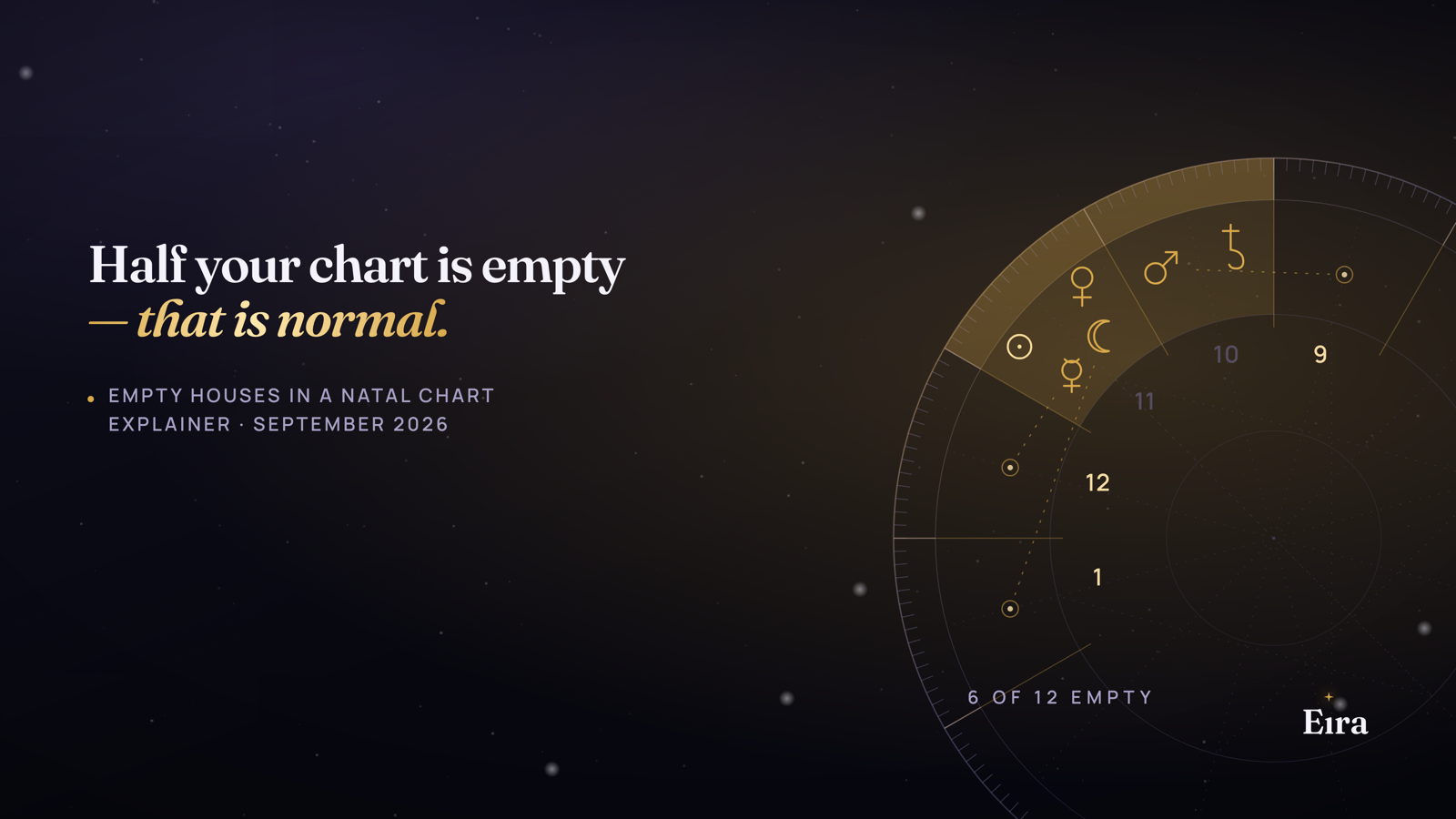
You open your chart, find the seventh house — relationships — and there is nothing in it. Not a single planet. The second, the money one: empty. The tenth, career: empty too. Five minutes in, it looks like life has been cancelled in three places at once, and all that is left is to find out why.
It hasn't been. Empty houses in a natal chart are universal, and for almost everyone the empty ones outnumber the occupied. This is not a quirk of your chart — it is arithmetic, and arithmetic is the easiest place to start.
More than half of every chart is empty
A chart has twelve houses and ten points to put in them: the Sun, the Moon and eight planets. Even if those ten spread out perfectly evenly, two houses would still come up empty. Ten into twelve does not go.
And they never spread out evenly. Mercury never appears more than 28 degrees from the Sun, Venus never more than 48 — not an astrological rule but orbital geometry: both are closer to the Sun than we are, so from Earth we always see them near it. So the Sun and Mercury share a house in roughly one chart in two, the Sun and Venus in one in four. Three of your ten points travel as a group before the cards are dealt.
Here is how that plays out:
- six empty houses is the single most common outcome;
- five, six or seven empty houses covers eight people out of ten;
- four or more empty houses covers 98 people out of 100;
- only two empty houses — the perfectly even case — turns up in fewer than one chart in a thousand.
And the figure that usually settles nerves fastest: any particular house — the seventh, the second, whichever one worries you — is empty in about half of all charts. Half the people around you live with an empty relationship house. They fall in love, marry, separate, fall in love again, all with an empty seventh.
What a house is, and what "empty" actually means
A house is not a box with a part of your life stored inside it. It is a slice of sky — the sky above and below your horizon at the moment you were born. The circle is divided into twelve slices from the point rising in the east, and each takes charge of one area: the body, money, speech, family, children, work, partnership.
The boundaries depend on the time and place of birth; move the birth time twenty minutes and they move with it. The mechanics are laid out in our guide to the natal chart.
A planet inside a house does not answer "do I have this area of life". It answers "is somebody standing in it pulling attention towards themselves". A planet makes its house loud: visible, demanding, often conflicted. Its absence does not switch the area off. It removes the permanent resident.
Which gives a simple rule: empty houses in a natal chart do not mean "nothing will happen here". They mean "nobody lives here full-time, asking for attention every day".
An empty house and an unimportant area are two different things
This is where nearly everyone slips on a first look at a chart. An area of life is not read from whoever stands inside the house, but from two things every house has, occupied or not.
First, the sign on the cusp. The cusp is the boundary, the line the house begins on, and a zodiac sign always sits on it. That sign sets the style: how you walk into this area, what you expect there, what you count as normal. Pisces on the seventh cusp and Capricorn on the seventh cusp are two very different approaches to intimacy — and both exist in a completely empty house.
Second, the ruler. Every sign has a planet that owns it. If that sign sits on your cusp, its planet is in charge of the area, wherever the planet itself happens to be. A planet inside the house is a tenant. The ruler is the landlord — and a landlord can live on the other side of town; the building is still his.
Who rules what:
- Aries — Mars · Taurus — Venus · Gemini — Mercury · Cancer — the Moon
- Leo — the Sun · Virgo — Mercury · Libra — Venus · Scorpio — Pluto (traditional ruler: Mars)
- Sagittarius — Jupiter · Capricorn — Saturn · Aquarius — Uranus (traditional: Saturn) · Pisces — Neptune (traditional: Jupiter)
Step 1. Find the sign on the cusp of the house you care about
Look not at the middle of the slice but at where it starts: a sign and a degree are written there. That is the half of the answer an empty house never takes away.
Step 2. Find the planet that rules that sign
Use the list above. Where there are two — Scorpio, Aquarius, Pisces — take both: the modern one describes the content, the traditional one the effort it costs you.
Step 3. See where the ruler stands and what it touches
That is the content of the area. An example: the seventh is empty, Capricorn sits on its cusp, so Saturn rules it, and Saturn sits in the tenth — work and public standing.
Read it out loud and you get this: relationships get built around the work. The partner arrives through a job rather than a party; who is responsible for what comes up early; there is little ease at the start, but what gets built tends to hold. All of that in an empty seventh — the house that supposedly has "nothing in it".
If Saturn sat inside the seventh instead of ruling it from the tenth, the conversation would be different; we wrote that up separately. The general reading order, from the angles down to the planets, is in our how to read a natal chart walkthrough.
Three honest readings of an empty house
The area runs by itself. Not "it isn't there", but "there is no argument going on inside it". It unfolds according to the sign on the cusp and the state of the ruler, with no separate engine of its own. Very often this is the part of life where a person does not get stuck.
The area gets switched on from outside. Transits — planets moving across the sky today that sooner or later stand exactly on the degrees of your empty house — work there just as well as in a crowded one. So do other people: their planets land in your empty houses and the area comes alive on contact.
A pile-up of planets is not good luck. A house with four planets is not "lucky with money", it is "this is where the loudest work happens". About one person in five has a house like that, and it is usually the area they discuss with the heaviest face in the room. An empty house means quiet far more often than it means failure.
Empty house by number: what to read instead of planets
Empty first house
It is never truly empty: the Ascendant sits on its cusp, and that point sets the way you walk into any situation. The sign of the Ascendant and its ruler describe how you are read before you say a word. Full breakdown of the big three.
Empty second house
Your own money, your possessions, your sense of your own significance. Empty means money does not turn into a daily drama by itself. Wherever the ruler sits is where money tends to come from: the sixth, steady work; the ninth, study and distance; the eleventh, the people around you.
Empty third house
Speech, learning, short trips, siblings, the people you see every week. An empty third does not make you quiet. Mercury's sign and house tell you how you think and talk; the sign on the cusp tells you the tone you take with the people nearest to you.
Empty fourth house
Family, roots, the place you come back to. Empty means the parent theme is not humming in the background all the time. The ruler of the fourth shows where home actually sits: in the eighth, tied up with family debts; in the ninth, in another country; in the sixth, in daily care and routine.
Empty fifth house
Children, falling in love, creative work, risk, play. An empty fifth gets read as "no children" constantly, and that is wrong: children are described by the ruler, the Moon and transits, not by the slice alone. Find the ruler — that is where your capacity to play and get carried away is kept.
Empty sixth house
Work as routine, health, daily rhythm, obligations. Empty means everyday life has not been turned into a battlefield. The ruler shows what holds your routine together and where the tiredness comes from; the sign on the cusp, how much load you take on.
Empty seventh house
Partnership: marriage, business partners, open opponents. The most common source of panic and, as it happens, the most common empty house. Read it from the sign on the cusp, the ruler, Venus, and whose planets land in your seventh. Empty usually means you are not building your whole life around a couple — not that there will be no couple.
Empty eighth house
Other people's money, credit, inheritance, crisis, deep intimacy. Empty means you are not drawn to live at the edge permanently. The ruler shows how shared resources reach you and what trusting another person actually costs.
Empty ninth house
Long journeys, higher education, worldview, belief. An empty ninth is not a sentence to stay home. Jupiter and the ruler show where you want to expand and what you run into when you decide to move abroad or go back to studying.
Empty tenth house
Career, status, reputation, direction. Empty means status is not your main internal engine — not that the career will not happen. The sign at the top of the chart (the Midheaven) and its ruler describe what you end up known for and where that ambition goes now.
Empty eleventh house
Friends, communities, plans for the future. Empty means your social circle is not the main stage of your life. The ruler shows where the people you need come from: work, study, family, the internet.
Empty twelfth house
Solitude, sleep, what you do with no witnesses, and what you hide from yourself. Empty here is often a relief: less hidden weight. The ruler shows where your energy goes when nobody is looking.
When an empty house does switch on
First, transits and eclipses crossing the degrees of that house. A planet reaches the empty slice and the area runs hot for weeks or months: an empty tenth does not stop you getting promoted in the year Jupiter walks through it.
Second, hits to the ruler. The house may be empty, but its landlord stands somewhere, and everything that happens to the landlord is delivered to the house. This works more often than a transit through the house itself.
Third, other people. In synastry — the comparison of two charts — a partner's planets fall into your houses, empty ones included. That is where "my personal life only started with him" comes from: the area was never switched off, it simply had no resident, and one arrived from outside.
How to check this in your own chart in five minutes
- Pin down your birth time. House boundaries move fast, and a wrong time shifts planets from one house into the next. Why it matters is covered in our piece on birth time.
- List the empty houses. There will be five to seven of them. That is normal.
- For each one, write down the sign on the cusp and its ruler. Two lines per house.
- Find which house and sign that ruler is in. That is your answer about the area.
- Look at the aspects it makes. Hard aspects show where the area grinds; easy ones show what carries it through.
Check the Moon separately too: it governs how you react and colours the emotional weather of every area. What it does in a chart is in our Moon breakdown.
Worth doing: reading an empty house through the sign on the cusp and its ruler · checking where the landlord lives and who it talks to · treating emptiness as normal, not as a diagnosis.
Not worth doing: judging an area of life from one empty slice · celebrating a pile-up of planets as good fortune · building a forecast on a chart cast from an approximate birth time.
Frequently asked questions
How many empty houses are normal?
Five to seven empty houses in a natal chart is the ordinary range. Six is the most common count, and 98 people out of 100 have four or more. Fewer than two is impossible: ten points cannot occupy twelve slices.
Does an empty seventh house mean I will never meet a partner?
No. The seventh house is empty in about half of all charts. Relationships there are described by the sign on the cusp, the planet ruling it and Venus — the story exists, it is just not written inside the slice.
Does an empty second house mean there will be no money?
No. An empty second house more often means money is not a daily internal preoccupation. Where it comes from is shown by the ruler of the second: its sign, its house and its aspects.
Which matters more, a planet in the house or the ruler of the house?
You need both, and they answer different questions. A planet in the house tells you the area is loud and demanding. The ruler tells you what it is made of and where it leads. When the house is empty, that second half of the answer is still fully there.
Can an empty house become occupied?
Not natally — the positions you were born with do not change. But the area is switched on by transits, progressions and people: planets cross those degrees regularly, and in such periods the house behaves exactly like an occupied one.
Can I look at houses at all if I don't know my exact birth time?
Carefully. Without a time the boundaries are unreliable, and an "empty" house may turn out to be occupied. Signs and aspects between planets stay valid, so it is better to postpone the houses until the time is confirmed.
Eira builds your chart from the date, time and place of birth and shows not only the planets in your houses but the cusps and their rulers — the half of the answer that stops an empty house from looking empty.