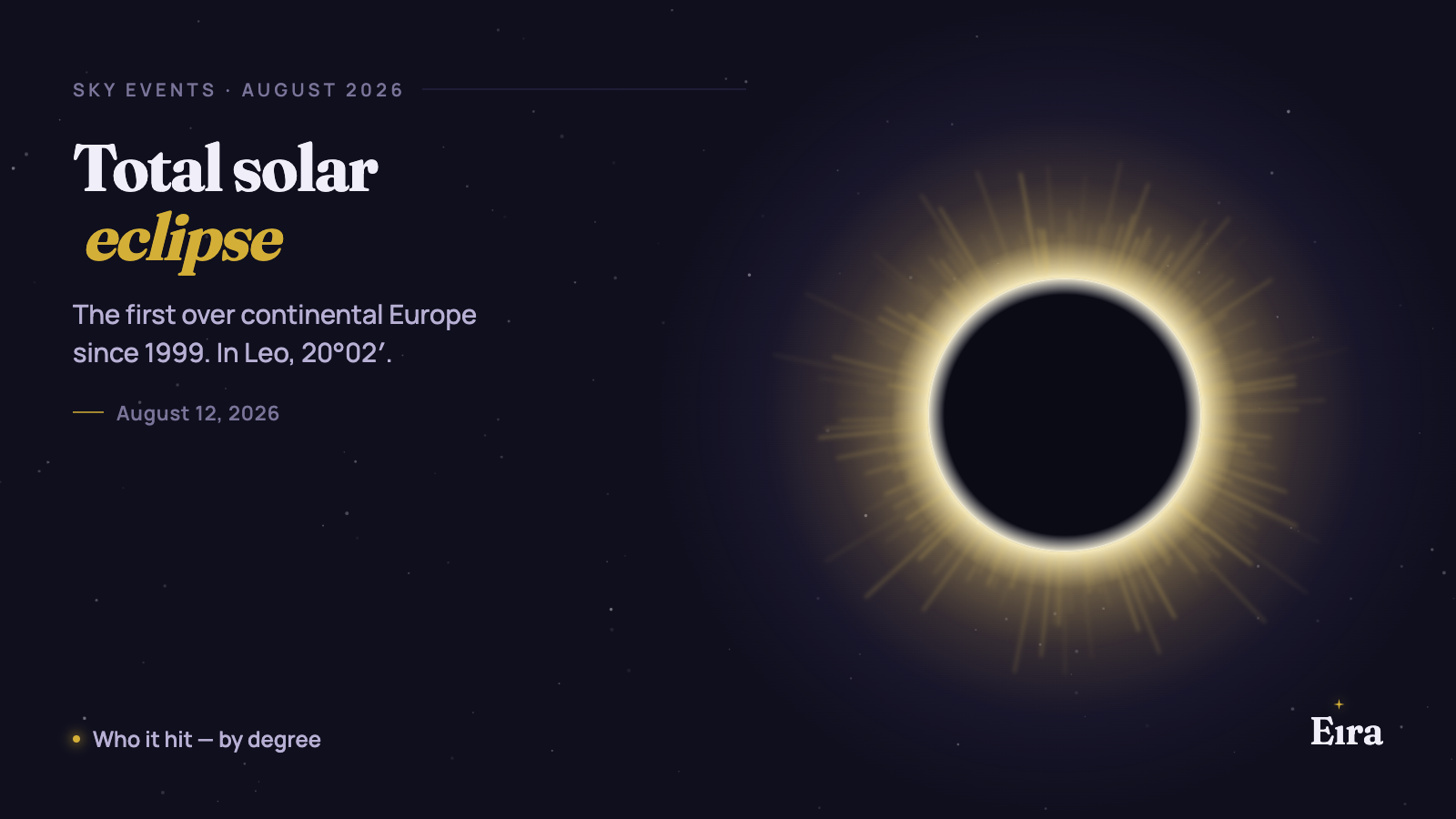
On August 12, 2026, a total solar eclipse occurred at 20°02′ Leo. It was the first total solar eclipse over continental Europe since 1999: the path of totality crossed Iceland and northern Spain.
If you're reading this after August 12 — good timing. Eclipses don't work on the day itself. They unfold over roughly six months, and the important part usually lands four to six weeks later.
How an eclipse differs from an ordinary new moon
A solar eclipse always happens at a new moon, but it behaves differently.
An ordinary new moon says "you may begin." It starts a cycle, locally and briefly: you feel it for a few days.
An eclipse says "something is leaving to make room." The effect stretches across about six months, and the change itself often only becomes clear in hindsight.
Hence the classic mistake: making a big decision on eclipse day, riding the surge, and discovering two months later that it was the wrong call at the wrong time.
Why Leo — and what that changes
Leo is a fixed fire sign. Its themes: who you are, what you shine with, the right to be seen, creativity, children, love, self-respect.
Leo's ruler is the Sun. During an eclipse the Sun is covered, and with it that particular kind of self-reliance switches off for a while. That's why so many people described these days not as sadness but as an odd "am I even the right person for this."
The core theme of this eclipse — stop playing a role you've outgrown.
What it brings to the surface:
- the role you've outgrown but keep performing because it's expected of you
- creative work postponed until "there's time"
- the right to take up space without apologising for it
- relationships where you shine at half strength so as not to outshine someone
- recognition you're waiting for from people who don't know how to give it
Who it actually hit
Here's what separates astrology from a horoscope "for all Leos."
An eclipse works by degree, not by sign. This one landed at 20°02′ Leo, and it touched people who have something sitting near that point in their chart.
By birth date — a rough estimate
The Sun moves about one degree per day. So the hit lands on those born closer to the twentieth day of their sign:
Leo, August 10–16. Eclipse directly on the Sun. The loudest position: the question "who am I now" arrived at full height.
Aquarius, February 5–11. Exactly opposite. The theme of partnership: who's beside you and whether they belong there.
Taurus, May 8–14. Square — tense but productive. Home, roots, the ground you stand on.
Scorpio, November 10–16. Also square. Work and reputation: are you doing the right thing.
Every other sign gets it as background.
By birth chart — the precise answer
Your Sun sign is a quarter of the picture. Three things actually matter:
Degree. Whether you have planets at 17°–23° of any fixed sign: Leo, Aquarius, Taurus, Scorpio. The usual orb for an eclipse is three degrees. If you have nothing in that band, the eclipse passed you as background noise, whatever the feeds say.
House. Which house of your chart holds 20° Leo. The house answers "in what area of life": the 2nd is money, the 7th relationships, the 10th career, the 12th what stays hidden. This is exactly why two Leos live through the same eclipse completely differently.
Which planet was hit:
- Sun — a renewal of role and identity itself
- Moon — an emotional reset, feelings surfacing
- Mercury — thoughts and decisions shift, an important conversation
- Venus — a turn in relationships or in what you value
- Mars — a change of course through action, often abrupt
- Ascendant — how you come across and how you're seen changes
What happens over the next six months
Eclipses don't end on their date. The usual shape:
First two weeks — feeling knocked off balance, tired for no reason, wanting to change everything immediately. Decisions made now tend to be revisited.
Four to six weeks in — the actual thing. This is often when it becomes clear what change was set in motion.
Through February — the theme plays out. By the next eclipse on this axis it's usually obvious what left and what took its place.
What to do and what to avoid
Do:
- write down what happened these days and what you were thinking. Reread it in six months — it's the single best tool for working with an eclipse
- watch what leaves on its own. Eclipses rarely take what you needed
- postpone anything major by two or three weeks
Avoid:
- signing something important on a wave of inspiration
- tearing down what took years to build
- looking for drama if your chart shows no hit
Frequently asked questions
Is the August 12, 2026 eclipse a bad thing? An eclipse isn't good or bad. It's a point of change: something ends, something begins. The hard part is the process, not the outcome.
How long does an eclipse last? About six months, until the next eclipse on the same axis. The most noticeable part comes four to six weeks in.
I felt nothing. Is that normal? Yes, and it's a result too. If your chart has no planets in the 17°–23° band of the fixed signs, the eclipse passed as background.
What was the second eclipse in August? On August 28 there was a lunar eclipse in Pisces at 4°51′. Solar eclipses are about beginnings, lunar ones about endings. Two eclipses in one month is a real load, and the exhaustion of late August is partly explained by it.
Check your own chart
Your Sun sign can't answer "did this hit me." Degrees and houses can — which means your birth chart.
Eira builds it free in two minutes and shows you where 20° Leo falls in your chart, which planets landed in the eclipse zone, and what that means for you specifically.