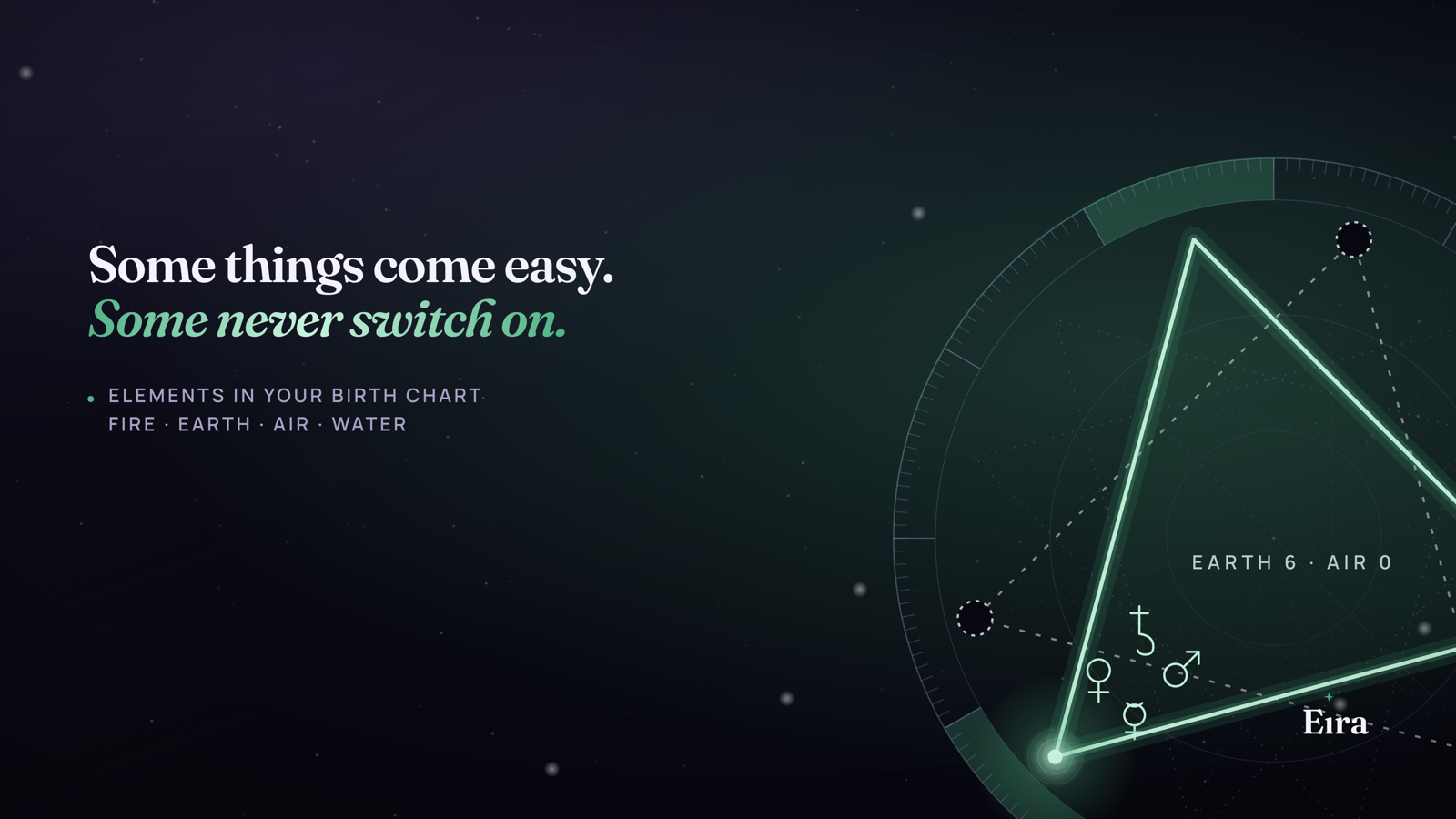
You're an Aries, and for three weeks now you haven't been able to send a single job application. Everyone expects you to charge ahead. Instead you sit over the cover letter, rewriting the first line for the fifth time.
Or this. You're a Pisces, yet when your friends need someone to plan the holiday budget day by day, they call you — because you're the only one who will actually finish the spreadsheet.
Or this. For the third time this year someone tells you "you overthink everything," and you honestly can't see how anyone decides anything without thinking it through first.
Your Sun sign explains only part of this. The rest comes down to how the elements in your birth chart are spread out: which one you have plenty of, and which one is nearly missing. Below is how to count them in five minutes, and what to do with the result.
The elements in your birth chart: four ways of getting things done
The twelve signs fall into four elements, three signs each:
- Fire — Aries, Leo, Sagittarius;
- Earth — Taurus, Virgo, Capricorn;
- Air — Gemini, Libra, Aquarius;
- Water — Cancer, Scorpio, Pisces.
An element is not a personality type, and it is not an "energy." It is the way you approach anything you do. The shortest version: Fire starts, Earth finishes, Air explains, Water feels.
Each element comes with its own core question. Fire asks "what do I want?" and keeps going for as long as the wanting lasts. Earth asks "what will this actually come to?" — in money, in deadlines, in the body. Air asks "how do I make sense of this, and who do I tell?" Water asks "what am I feeling here, and who matters to me?"
Everyone has all four questions. The difference is which ones come up on their own, and which ones you have to ask yourself on purpose — or only remember when it's too late.
Why your Sun sign doesn't tell you your element
The Sun is one point out of ten or more. The Moon, the Ascendant (the sign rising over the horizon at the moment you were born), Mercury, Venus and Mars all sit in signs too, and each of them adds its own element to the mix.
Here is a real example — the sky over Kyiv on the night of 12–13 April 1970. Sun in Aries. Moon in Cancer. Ascendant in Capricorn. Mercury, Venus, Mars and Saturn — all four in Taurus. Jupiter in Scorpio. By Sun sign, this person is an Aries, a fire sign.
But the chart has exactly one Fire point: the Sun itself. It has five Earth points, counting the Ascendant. And no Air at all.
An Aries like this really can spend a month on one job application. The decision has to feel solid first (Earth), and there's no easy way to put into words why it's taking so long (no Air).
If you score the elements with the method below across 20,000 random birth dates, for one person in three the Sun's element is not the strongest one in the chart. So the question "do I even fit my sign?" is a perfectly fair one. How the Sun, Moon and Ascendant work together is covered in our guide to the Big Three.
How to count the elements in your birth chart
There is no single standard. Different schools give the planets different weights. What follows is a simple method that is good enough to show you where the imbalance is. A strong imbalance shows up under any sensible scoring system; only the borderline cases are up for debate.
Step 1. Write down the signs of eight points
Sun, Moon, Ascendant, Mercury, Venus, Mars, Jupiter, Saturn. Leave out Uranus, Neptune and Pluto: each stays in one sign for seven to twenty-plus years, so everyone in your school year has the same placements. They say very little about you personally.
The Ascendant needs an accurate birth time. If you don't have one, skip it and be more careful with your conclusions — our piece on why birth time matters explains why.
Step 2. Hand out the points
- Sun, Moon and Ascendant — 2 points each: they are the core of who you are.
- Mercury, Venus, Mars, Jupiter and Saturn — 1 point each.
That makes 11 points in total. Add them up by element. For the Aries example above, you get Fire 2, Earth 6, Air 0, Water 3.
Step 3. Read the result
- 5 points or more — a dominant element. This is how you operate by default, even when it doesn't fit the situation.
- 2–4 points — a working element.
- 0–1 point — a missing element. That doesn't mean "I don't have this." It means "this doesn't switch on by itself."
Imbalance is the norm, not the exception. Using the same method, two people in three have one element scoring 5 or more, eight in ten have an element with one point or none, and a completely empty element turns up in about four people out of ten.
When you have a lot of one element
A dominant element is what comes to you without effort. It is also what you keep doing when the situation calls for something else.
A lot of Fire
You start faster than anyone and get people moving with a single "let's do it." Waiting is torture: while everyone else is still agreeing on the plan, you've already done it. The cost is ten projects started and boredom setting in around week three of each. Exhaustion doesn't build gradually — it hits all at once. You burn and burn, and then one day you can't get off the sofa.
A lot of Earth
People can count on you: if you say "I'll do it," it gets done, on time and with something to show for it. What's hard is changing a plan once it has stopped making sense, and trusting anything that hasn't been measured yet. Enjoyment gets postponed until "when everything is done" — and everything is never done.
A lot of Air
You understand everyone, you can explain complicated things in plain words, and you keep a cool head while others panic. The flip side: talking about a feeling instead of actually feeling it. And decisions that keep getting postponed as long as there is one more point of view you haven't considered.
A lot of Water
You sense that something is off in a room before anyone says a word. People open up around you. But you take other people's moods home with you, and you can't always tell "I feel bad" apart from "the person next to me feels bad." Hurt stays with you longer than it does with others — not because you hold grudges, but because you genuinely feel it.
When an element is almost missing
This is the part that matters most. An element with one point or none doesn't mean you lack that quality. It means the quality doesn't switch on by itself — you have to switch it on manually.
There is another pattern, described by the American astrologer Stephen Arroyo back in the 1970s: people often don't avoid their missing element — they overcompensate for it, doing it deliberately, with effort, and too much. That's why "low Earth" can look like obsessive control over every purchase, and "low Water" like one single attachment that everything has been poured into.
Low Fire
It's hard to say "I want" — you'd rather someone gave you permission first, or at least asked. Other people's enthusiasm lights you up, and you go flat when they leave. Then, when you can't take it any longer, you make a move so abrupt that it startles everyone around you. That's the overcompensation.
What helps: small starts instead of big decisions, deadlines set by someone else, and people who make you want to move.
Low Earth
Money disappears, even though you can't remember buying anything. Your body only gets your attention when it hurts. Your ideas are good, but only one in ten makes it to a finished result. Or the reverse — overcompensation: spreadsheets for everything, a to-do list for every day, and anxiety whenever something isn't written down.
What helps: a routine you don't have to reinvent every morning, simple physical basics — sleep, food, a walk — and finishing one project before starting the next.
Low Air
It's hard to explain what's going on with you: "it's just like that." You decide by gut feeling, and then struggle to defend the decision in an argument, even though it's often right. Conversations that need quick, precise wording drain you. The overcompensation looks like endless reading and courses, always with the sense that a little more research will finally make it all clear.
What helps: writing things down, even as notes on your phone; talking out loud with someone who doesn't interrupt; and giving yourself time to answer instead of replying on the spot.
Low Water
People call you cold, even though you do care. Feelings reach you a day or two late: you hold it together when things are hard, then cry at an advert a week later. When someone cries next to you, you freeze and start solving a problem instead of simply being there. The overcompensation is one very strong attachment — to a person, a pet, a place.
What helps: putting a word to the feeling, even a rough one ("I think I'm hurt"), noticing body signals — tight shoulders, a lump in your throat — and not demanding that you react "on time."
What balances a missing element
The point count is a starting point, not a verdict. Four things can shift the picture noticeably.
One loud planet. A single point of Fire can outweigh three points of Earth if it's Mars sitting right on the Ascendant or at the top of the chart, or a planet with lots of aspects (links to other planets). A spot where several planets meet works like several points at once — see our guide to conjunctions.
Houses. Each house also has an element, by number: houses 1, 5 and 9 are Fire; 2, 6 and 10 are Earth; 3, 7 and 11 are Air; 4, 8 and 12 are Water. If you have little Earth by sign but several planets in the 2nd, 6th or 10th house, earthly tasks are very much part of your life — they just arrive as circumstances rather than temperament. How to read houses, including empty ones, is covered in our article on empty houses.
The Moon. If Water is your missing element but your Moon is strong — sitting on an angle of the chart or closely aspecting the Sun — you are more sensitive than the count suggests. More on that in our guide to the Moon in the birth chart.
Other people. We are often drawn to people who have plenty of the element we lack: someone with no Earth feels calm next to someone with six points of it. That works until each starts demanding the other become more like them. How two charts are compared is explained in our article on synastry.
Elements and your Sun sign: what each sign should check
Your Sun sign gives you one element out of four. Here's what to check first, depending on your sign.
Aries (Fire)
If your Fire adds up to just 2 points — the Sun alone — your drive shows up at the start and runs out quickly. Look at Mars, your sign's ruling planet: if it's in Earth or Water, your decisiveness is slow and targeted rather than explosive.
Taurus (Earth)
Your steadiness comes from the Sun, but with 6 or more points of Earth it picks up a stubbornness that others mistake for laziness. Check your Air: with 0–1 point, it's hard for you to explain why you won't change your mind, and arguments turn into silence.
Gemini (Air)
The main thing to check is Earth. With 0–1 point you have plenty of started courses, notes and plans, and not much finished. Saturn in your chart shows where you do know how to stay the course.
Cancer (Water)
A common imbalance is Water and Earth with no Fire: you know how to look after others, but saying "I want this for myself" can take years. Look at where Mars sits — that's where your right to your own wants lives.
Leo (Fire)
On the outside you look confident. But if your Moon is in a water sign and you have 4 or more points of Water, that confidence depends on how people respond to you. Silence hurts you more than criticism.
Virgo (Earth)
If a lot of Air joins your Sun, analysis becomes an end in itself and decisions drown in clarifications. If you have 0–1 point of Water, you show care through actions rather than words — and the people close to you don't always realise that was care.
Libra (Air)
Check your Fire. With 0–1 point, decisions get postponed until someone makes them for you — and then you're unhappy with how they were made. A strong Mars in your chart goes a long way towards correcting this.
Scorpio (Water)
With 0–1 point of Air, you feel deeply but can't name it. So you stay silent for a long time, then say everything at once and more sharply than you meant to. Mercury in your chart shows which language comes easiest when you talk about yourself.
Sagittarius (Fire)
The most common imbalance is low Earth: plenty of ideas, trips and plans, no budget and no deadlines. Saturn and Jupiter, your ruling planet, together show how your "I want" and your "can I carry this?" are wired.
Capricorn (Earth)
The "cold" label almost always means 0–1 point of Water. Check your Moon: if it's in Earth or Air, the feelings are there, but they come out as responsibility rather than words and hugs.
Aquarius (Air)
With little Water, you understand everyone's feelings — in theory — and notice your own far too late. Add a lot of Fire, and you tend to leave before a conversation has a chance to get heavy.
Pisces (Water)
Check your Earth: with 0–1 point, boundaries, time and money are hard, and you're easily talked into things you didn't want. With little Fire, "no" is hard to say, and "I want" is harder still.
What to do about an elemental imbalance
An imbalance of elements in your birth chart doesn't need fixing. It needs knowing. Your dominant element is your default way of acting; your missing element is where you need some support — a habit, a deadline, a person nearby. Trouble starts when you expect yourself to do easily what doesn't switch on by itself, and then call yourself weak for struggling.
Do: count your points at least once · notice where you act on autopilot even when the situation needs something else · give your missing element one simple outside support · look at houses and strong planets, not just signs.
Don't: decide you're a "wrong Aries" because you have little Fire · draw conclusions from the Ascendant if your birth time is uncertain · expect a partner to supply your missing element forever without getting tired of it.
The general order for reading a chart — from the angles to the planets and aspects — is laid out in our step-by-step guide to reading your natal chart.
Frequently asked questions
Short answers to what people ask most often when they first count their elements.
How do I find out which element dominates my birth chart?
Write down the signs of your Sun, Moon, Ascendant, Mercury, Venus, Mars, Jupiter and Saturn. Give the Sun, Moon and Ascendant 2 points each and the rest 1 point each, then add them up by element. There are 11 points in total: 5 or more means a dominant element, 0–1 means that element is almost missing.
What does it mean if I have no planets in one element?
It's common: with this method, about four people in ten have one element completely empty. You still have that element's qualities, but they don't switch on by themselves — you have to engage them deliberately. People often overcompensate for their missing element.
Should I count Uranus, Neptune and Pluto?
Not in a simple count. These planets stay in one sign for seven to twenty-plus years, so a whole generation shares the same placements. If you want to include them, give them no more than half a point each.
Are elements by sign and elements by house the same thing?
No. Signs describe temperament — how you act. Houses describe the areas of life where it happens. Houses 1, 5 and 9 are associated with Fire, 2, 6 and 10 with Earth, 3, 7 and 11 with Air, and 4, 8 and 12 with Water. If an element is low by sign but strong by house, its tasks come to you as circumstances.
Can I count the elements without a birth time?
Partly. Without a birth time the Ascendant is unknown, and that's 2 of the 11 points. Count the remaining seven, but be careful with "this element is missing" — the Ascendant might be exactly what supplies it. The Moon can also change sign within a day, which is worth checking.
Does element compatibility actually work?
The classic rule — Fire gets on with Air, Earth with Water — applies to Sun signs and gives only a very rough picture. Comparing two whole charts tells you far more: which element each person lacks, and which of you supplies it.
Eira builds your natal chart from your date, time and place of birth and shows which sign your Sun, Moon, Ascendant and every planet is in — so adding up the points takes a couple of minutes. And in the chat you can ask what in your chart balances out your missing element.