You did good work, the client is happy, and now they ask, "So what do I owe you?" Suddenly you're stalling: "Oh, whatever you think is fair," even though that morning you knew the exact number. Or a different scene: your salary went up this year, there's more in your account than ever, and the feeling of "it won't be enough" hasn't moved an inch. None of this is really about money. This is second house territory.
Here's what the second house is and what lives in it, why money and self-worth ended up in the same part of the chart, how to find it in your own chart in three steps, what it looks like with each of the twelve signs, and which planets change its character.
What is the 2nd house in astrology?
A birth chart is divided into twelve sectors called houses, and each one covers an area of life. For how the whole wheel fits together, see your natal chart explained.
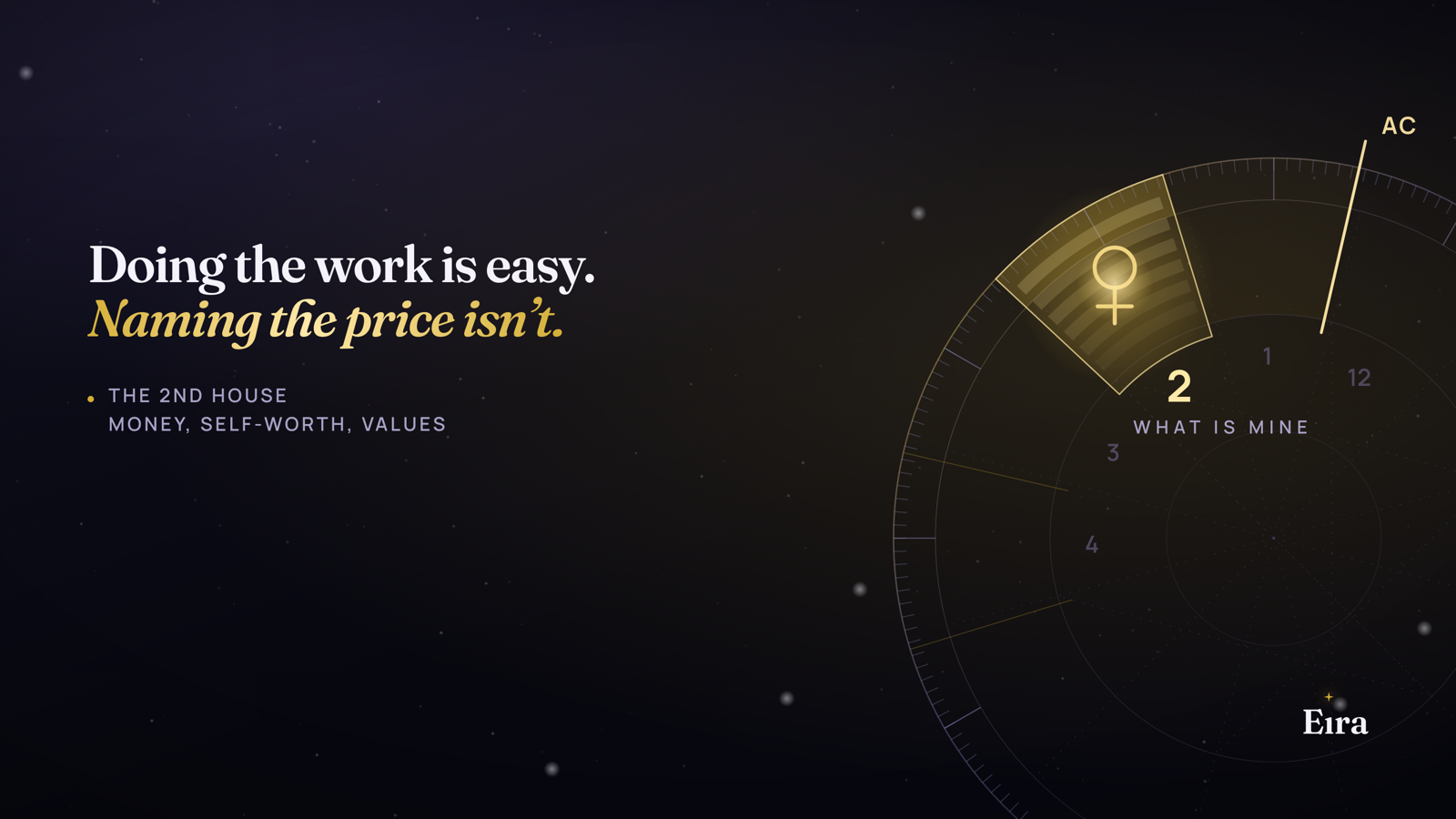
The second house comes right after the first. The first house is you: how you meet the world and how people see you at first glance. The second is what belongs to you and what you lean on: money, possessions, skills, and your own sense of what you're worth. If the first house answers "who am I?", the second answers "what do I have, and what am I worth?"
The second house has a natural sign, Taurus, and a natural planet, Venus. That's why its themes feel so Taurean: stability, slow accumulation, pleasure in things you can touch. But in your own chart any of the twelve signs can sit at the start of the second house, and that sign shapes the house more than its Taurus connection does.
In one sentence: the second house isn't about how much money you have. It's about what gives you the feeling of solid ground under your feet.
What lives in the second house
Your own money: how it comes in and where it goes
Salary, fees, anything you earned yourself and spend as you see fit. The second house doesn't show the size of your income. It shows how you handle money: some people earn in bursts and spend the same way, others put something aside from every paycheck and get nervous when their cushion drops below three months. Shared money, loans and a couple's budget belong to a different house, covered below.
Self-worth: the price you put on yourself
The number you can't say out loud. The second house describes your internal bar: what salary feels "normal for someone like me", what raise you dare to ask for, how many times you talk yourself out of buying a good coat. When that bar is set too low, you spend years working for less than you could earn and genuinely can't see why.
Values: what you'll happily pay for
One person pays for good food without a second thought and saves on clothes; another does the opposite. One will spend their last savings on a trip, another on fixing up the apartment. The second house shows what you actually value, and you see it not in what you say but in a month of bank statements.
Talents you can turn into income
This house also covers the abilities you earn from, or could: your voice, your taste, your hands, a head for numbers, a knack for negotiating. In the classical reading, the second house is the set of resources you have before any job. That's why it hints at where income will come most easily.
Possessions and physical comfort
A favorite mug, comfortable shoes, a warm blanket, a good meal. Through physical comfort the second house tells your body "everything's fine". When that sense of security runs low, people often start shopping, not because they need the thing, but because buying it calms them down for a minute.
Why money and self-worth share a house
It's not a random pairing. The price you name for your work is almost always the price you put on yourself. As long as a voice inside says "I already earn enough for my level", no market boom will raise your income, because you simply won't ask for more.
It works the other way too. Someone with a high salary and low self-worth can live in constant money anxiety, because the problem isn't the amount. The feeling of "I have something to stand on" doesn't come from your banking app. It comes from the second house.
The practical takeaway: working with your second house isn't only about budgeting. Sometimes the most profitable thing you do all year is one conversation in which you name your rate for the first time without apologizing.
How the 2nd house differs from the 8th, 6th and 10th
- The 8th house is money that someone else has a stake in: a shared budget, loans, inheritance, taxes. The second is money you earned yourself. That's why someone can earn confidently and still freeze when it's time to split shared finances. More in the 8th house in astrology.
- The 6th house is daily work, routines, duties. The second isn't the work itself, but what you get for it and how much you value that.
- The 10th house is career, status, reputation. You can hold a prominent title with a modest second house, or quietly earn well with no status at all.
The second and eighth houses sit opposite each other and form one axis: "mine" and "ours". How that axis works through the signs is covered in the Taurus–Scorpio axis.
How to find your 2nd house in three steps
You need a chart with an accurate birth time. House boundaries shift every few minutes, and without a time the houses can't be calculated at all. Here's why: why your birth time matters.
A quick hint before you calculate anything: if you were born in the middle of the night, roughly two to four hours before sunrise, your Sun is most likely in the second house. Before it rises, the Sun moves below the horizon through the second house and then the first. The exact boundaries depend on the season and your latitude, so treat this as an estimate, not an answer.
Step 1. The sign at the start of the house
Find the line where the second sector begins, called the cusp. The sign on it sets the style: how you earn, how you spend and what your self-worth rests on. Most often it's the sign right after your Ascendant sign. Descriptions for every sign are below.
Step 2. Planets inside the house
Check whether any planets sit in your second house. Each one adds its own theme: with Saturn, money arrives slowly; with Jupiter, it comes easily and leaves just as easily. If there are no planets, the house isn't "empty". It works through the sign on its cusp and that sign's ruler.
Step 3. The ruler of the sign and its house
Every sign has a ruling planet: Aries has Mars, Taurus and Libra have Venus, Gemini and Virgo have Mercury, Cancer has the Moon, Leo has the Sun, Scorpio has Pluto, Sagittarius has Jupiter, Capricorn has Saturn, Aquarius has Uranus, and Pisces has Neptune (traditional astrology gives Scorpio to Mars, Aquarius to Saturn and Pisces to Jupiter). Find the ruler of the sign on your second house cusp and see which house it occupies. This is one of the most practical clues in a chart: it shows where money comes to you most readily.
- Ruler in the 3rd house: income through words, writing, messaging, sales, travel.
- In the 5th: through creative work, hobbies, working with children.
- In the 6th: through a craft and daily hands-on or skilled work.
- In the 7th: through partners and one-on-one clients.
- In the 9th: through education, teaching, other countries.
- In the 10th: through career, position and reputation.
- In the 11th: through teams, communities and online audiences.
The sign on your 2nd house cusp: how you earn and spend
Aries
Money in bursts: earned fast, spent just as fast. Income grows where you can start your own thing without waiting for permission. Self-worth rests on being first, and the main trap is impulse purchases you regret by evening.
Taurus
Taurus is the natural sign of the second house, so its themes are loudest here. Money builds slowly and reliably, and things are bought once and kept for years. The main trap is clinging to a stable job you outgrew long ago, simply because it's stable.
Gemini
Several income streams at once: a main job, a side gig, a passion project. Money comes through words, connections and the ability to figure things out quickly. You spend on books, courses and gadgets, and self-worth often depends on how smart people think you are.
Cancer
Money equals the family's safety. There's a rainy-day fund even if you never mention it to anyone. Income can rise and fall with your mood, and it's easier to spend on home and loved ones than on yourself.
Leo
Money is for generosity: gifts, dinners out, grand gestures. Income grows when you're visible, through creative work, a public role, a personal brand. Self-worth is tied to recognition, so behind-the-scenes work can stay underpaid for years.
Virgo
A spreadsheet budget, saved receipts, price comparisons. Money comes through skill, precision and doing things well. The main trap is undervaluing your work: "it's not good enough yet to charge more."
Libra
Money through people, partnerships and aesthetics. You spend on beauty and on keeping things pleasant. Naming your price is especially hard, because a blunt number feels like it might spoil the relationship with the client.
Scorpio
Money isn't discussed, neither income nor debt. It's all or nothing: stretches of strict saving alternate with big decisions. You're good at managing other people's resources and investing strategically, and your self-worth gets tested by crises.
Sagittarius
Money through knowledge, teaching, travel, work with other countries. An "it'll work out somehow" optimism that often proves right and occasionally doesn't. You'd rather spend on experiences than on things.
Capricorn
Money comes slowly, through discipline and years of work. A fear of being poor often shows up early, which is exactly why income gets built on solid foundations. This second house only grows stronger with age, and self-worth rests on achievement.
Aquarius
Unconventional income: tech, freelancing, projects that didn't exist a year ago. Earnings come in jumps. Money matters as a means of freedom, and the main goal is never depending on a single employer.
Pisces
Money slips away unnoticed, and the boundaries around it are blurry: it's easy to give it away, lend it, or not charge at all. Income can come through creative work, helping people, intuition. This second house needs simple tracking rather than a strict budget, just enough to see where it all goes.
Planets in the 2nd house: what to look for in your chart
- Sun: self-worth is tied directly to what you can do and what you earn. You feel most like yourself when you see the results of your work in money or things.
- Moon: income and spending follow your mood. Shopping to calm down is familiar territory. More in the Moon in your natal chart.
- Mercury: money through your mind and your words: negotiation, writing, trade, consulting.
- Venus: the natural planet of the second house and one of the easiest placements for money. Taste, the ability to enjoy things, and earning through what people find pleasant. The full picture is in Venus in your natal chart.
- Mars: you earn actively, by pushing, and spend the same way. Money becomes a field for competition and thrill.
- Jupiter: generosity toward yourself and others. Money usually turns up, but it also flows out freely: expenses grow along with income.
- Saturn: money comes slowly and through hard work, especially when you're young. But what you build lasts. A common side effect is feeling "it won't be enough" no matter the amount.
- Uranus: unpredictable income, sudden turns, earning from things that are new and unusual.
- Neptune: blurry money boundaries. It's easy to overpay, lend without paperwork, or believe in a "great deal". The upside is earning through creativity and imagination.
- Pluto: money as a question of power and control, as in "whoever pays makes the rules". Huge potential for change if you're willing to work with this. More in Pluto in your natal chart.
If one of these planets is retrograde in your chart, second house themes tend to play out internally first: you rethink before you act. More in retrograde planets in a natal chart.
An empty 2nd house doesn't mean no money
If there are no planets in your second house, that says nothing about poverty or not caring about money. There are ten planets and twelve houses, so every chart has empty ones. In that case your money and self-worth are described by the sign on the cusp and where its ruler sits. More in empty houses in a natal chart.
Why the 2nd house feels louder right now
Venus, the natural ruler of the second house, is moving backward until 14 November 2026. Periods like this bring up questions about what you value and what you pay for: you may want to cancel subscriptions, return something you bought, or remember what you actually charged for your work a year ago. It's background, not a verdict on your wallet. Decisions made after Venus turns direct usually come out calmer. More in Venus retrograde back in Libra.
Is it your income or your self-worth?
Three questions that help tell them apart:
- Can you say the price of your work out loud without adding "but let me know if that's too much"? If not, your second house is asking you to work on your price, not your workload.
- Do you only buy yourself something good "for a special occasion" or on sale? If so, your sense of what you deserve sits lower than your budget does.
- Does the "it won't be enough" feeling change when there's more in your account? If not, it isn't about the amount. It's about a kind of security money can't buy.
What to do and what to avoid
⚖️ What to do
- Once a month, open your bank statement and read it as a list of your real values: where did most of it go, and do you agree with that?
- Name your price first, as a single number, with no preamble and no excuses.
- Find where the ruler of your second house sits in your chart and check whether you're using that area of life to earn.
- Learn to tell "I need this thing" apart from "I need to calm down right now".
⛔ What to avoid
- Measuring your worth only by your account balance.
- Settling for less out of fear that nobody will offer more.
- Reading the second house as a forecast of wealth or poverty. It describes how you handle resources, not the size of your wallet.
Frequently asked questions
What does the 2nd house mean in astrology?
The second house covers your own money, possessions, the talents you can turn into income, and self-worth: the value you place on yourself. It doesn't show how big your income is. It shows how you earn, how you spend and what gives you a sense of solid ground.
Which planet rules the 2nd house?
The natural planet of the second house is Venus, and its natural sign is Taurus. In your personal chart, though, the ruler is specific to you: it's the planet that rules the sign on your second house cusp. If that sign is Capricorn, for example, your ruler is Saturn, and the house Saturn sits in hints at where your money comes from.
How do I find out which sign is on my 2nd house?
You need a natal chart with your exact date, time and place of birth. The sign on the line where the second sector begins is the sign of your second house. Eira calculates houses with the Placidus system, the most widely used one. Other house systems may put a different sign on that cusp.
What does an empty 2nd house mean?
Nothing bad. Every chart has empty houses, because ten planets can't fill twelve houses. Second house themes still work through the sign on its cusp and that sign's ruler: wherever the ruler sits is where your money question points.
Which planets in the 2nd house are good for money?
Traditionally, Venus and Jupiter are considered the easiest: they make money flow more readily and make it more enjoyable. Saturn gives slow but solid income. No planet guarantees wealth or dooms you to poverty. What matters is how you use what the chart shows.
How is the 2nd house different from the 8th?
The second house is your own money, the money you earned and spend yourself. The eighth is money in which another person has a share: a joint budget, loans, inheritance, taxes. Together they form the axis of "mine" and "ours".
Which sign sits on your second house cusp, whether there are planets inside, and where its ruler is — your natal chart in Eira shows all of it. The Houses tab lists the sign on each cusp, and the Planets tab shows which house every planet is in. If you're new to reading a chart, start with how to read your natal chart. To calculate it, you'll need your date, time and place of birth.