It's the same argument about money. On Monday you calmly explain why the trip should wait. On Thursday your partner says almost the same thing, and you snap so hard that afterwards you can't work out where it came from.
Or the opposite. Things other people struggle with for weeks come easily to you: balancing the budget, getting a contractor to agree, calming a crying child. You don't even count it as a skill. "Come on, that's easy."
In a natal chart, both scenes have the same source. Planets in your chart never act alone. They are linked to each other, and those links are called aspects. Below are the five main ones, what each means in everyday life, and how to find them in your own chart in about ten minutes.
In one sentence: an aspect is the distance between two planets around the circle of your chart, and that distance decides whether they cooperate or clash.
What is an aspect in a natal chart?
Every planet in your chart stands for one part of your personality. The Sun: I choose. The Moon: I react. Mercury: I think and speak. Venus: I like, I value. Mars: I want, I act. Saturn: I take responsibility and hold the line.
An aspect shows how two of those parts get along inside one person. If the Moon and Mars are linked by a tense angle, hurt turns straight into action: a sharp word, a slammed door. If the same Mars sits at a soft angle to the Moon, feeling and action move together, without the jolt. Same planets, very different life.
That's why two people with the same Sun sign can be nothing alike. The sign describes a planet on its own. Aspects describe its relationships with everything else.
The five major aspects
Astrologers use more than a dozen aspects, but five of them carry the weight in any chart. They're called the major aspects.
Conjunction, 0°: two planets switch on together
Two planets sit at almost the same point, and their functions fuse. You can't think without feeling, or want something without first checking whether you're allowed to. A conjunction is nearly invisible from the inside: people assume everyone works this way. There's a full guide, with the most common pairs, in conjunctions in the natal chart.
What to do: ask the people close to you what always comes "as a package" with you. They'll spot it before you do.
Sextile, 60°: an opportunity you have to take
The planets are two signs apart, like Aries and Gemini or Taurus and Cancer. A sextile is an open door. It doesn't take you anywhere by itself, but once you walk through, things go surprisingly smoothly. Someone with Mercury sextile Venus may write beautifully about beautiful things, as long as they start instead of waiting for inspiration.
What to do: a sextile wakes up with the first step. Look for sextiles to your personal planets and ask yourself which step you keep putting off.
Square, 90°: friction on the inside
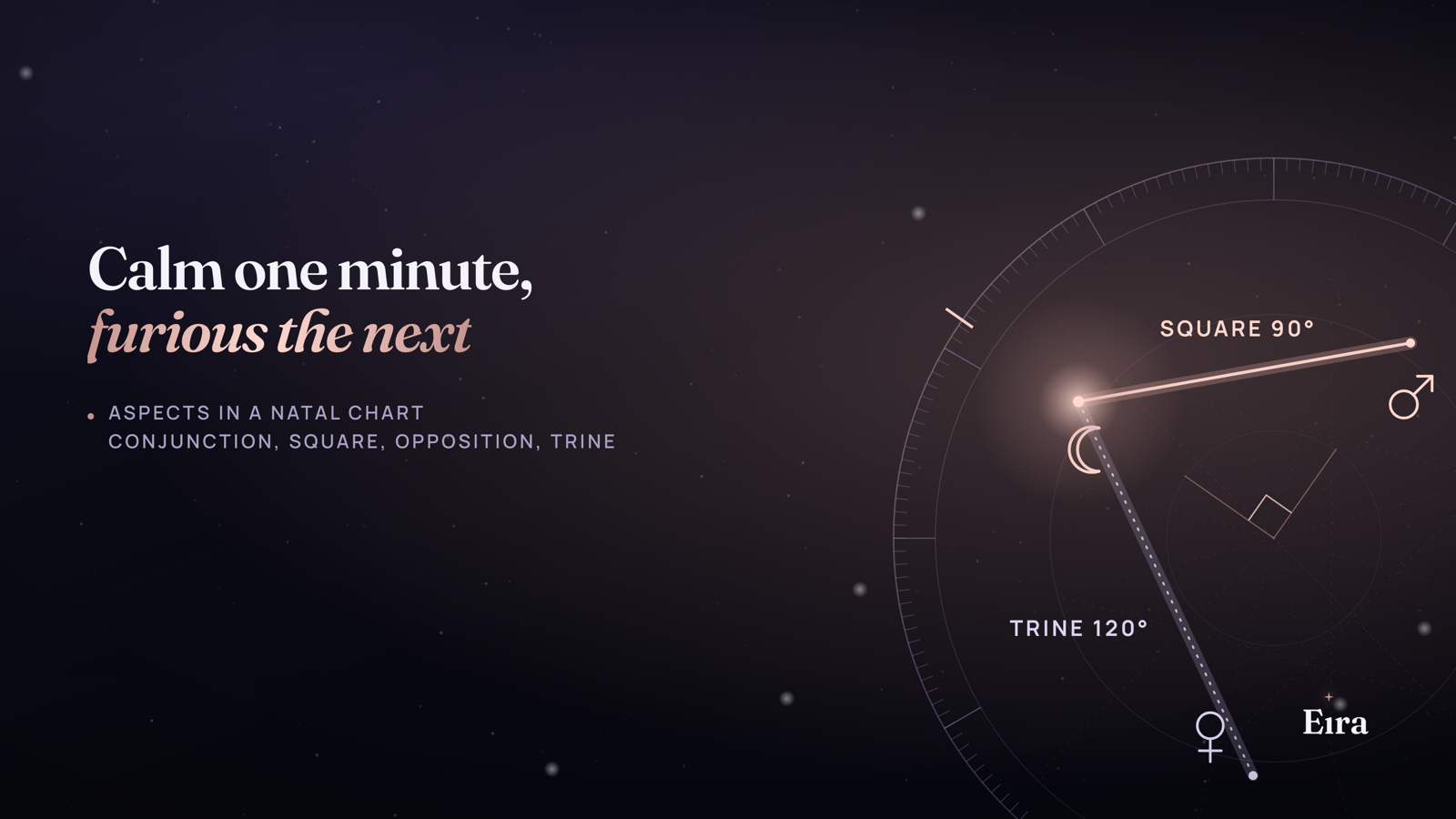
The planets are three signs apart, like Aries and Cancer or Leo and Scorpio. Two parts of you want different things at the same time. Venus wants closeness; Saturn wants proof first that you won't be left. That's where "calm one minute, furious the next" comes from. While a topic stays neutral, the inner argument stays quiet. The moment something touches both planets at once, it breaks out.
Squares are uncomfortable, but they push you to act. A lot of people's real strengths grew out of squares: you spend years learning what never came easily, and you end up better at it than the people who never had to try.
What to do: find one square and name it: "part of me wants ___ and part of me wants ___." A conflict you can name is a conflict you can manage.
Trine, 120°: what comes naturally
The planets are in signs of the same element. Aries, Leo and Sagittarius are fire; Taurus, Virgo and Capricorn are earth. The two energies understand each other without effort. This is the "that's easy" talent, the one that never feels like a talent. Why the element matters so much is covered in the elements in your natal chart.
The catch: a trine never forces you to do anything. You can go your whole life without using what you were handed for free.
What to do: list your trines and ask yourself honestly whether you actually use them or just "happen to be good at" them.
Opposition, 180°: the seesaw
The planets sit in opposite signs, like Aries and Libra or Cancer and Capricorn. Two parts of you pull in opposite directions, and you swing between them. Freedom or family. Work or home. Often you meet the other side through another person: a partner who "for some reason" always wants exactly what you gave up.
To see what an opposition looks like in the sky rather than in a chart, read Mars opposite Pluto.
What to do: instead of picking one side for good, look for ways both sides can take turns.
Orbs: why the angle doesn't have to be exact
Planets rarely sit at exactly 90° or 120°. The margin within which an aspect still counts is called the orb. The tighter the angle, the stronger the link.
Eira uses these orbs: up to 8° for conjunctions and oppositions, up to 6° for squares and trines, and up to 4° for sextiles. Some astrologers allow up to 10° when the Sun or Moon is involved. A wide aspect like that still works, but more as a background tone. It shows up under pressure rather than every day.
The loudest aspect in any chart is the one with an orb under 2°. Anyone who has known you for more than a week has noticed it.
How to find the aspects in your chart in 10 minutes
You need a natal chart built from your exact date, time and place of birth. The time matters more than people think. The Moon moves about 13° a day, so a birth time that's off by a few hours can create an aspect or erase one. More on that in why your birth time matters.
Step 1. A quick read by sign (3 minutes)
Write down the signs of your Sun, Moon, Mercury, Venus, Mars and Ascendant. Then look at the pairs:
- same sign: a possible conjunction;
- two signs apart (Aries and Gemini): sextile;
- three signs apart (Aries and Cancer): square;
- same element (Aries and Leo): trine;
- opposite signs (Aries and Libra): opposition.
This is a rough draft. It tells you where to look, but it doesn't prove an aspect yet.
Step 2. Check the degrees (4 minutes)
The angle decides, not the sign. Convert each planet's position into degrees around the circle. Aries starts at 0°, Taurus at 30°, Gemini at 60°, Cancer at 90°, Leo at 120°, Virgo at 150°, Libra at 180°, Scorpio at 210°, Sagittarius at 240°, Capricorn at 270°, Aquarius at 300° and Pisces at 330°. Add the planet's degree within its sign. Subtract one number from the other, and if the result is over 180, subtract it from 360.
Example: the Moon at 20° Aries (20) and Mars at 5° Cancer (95). The signs suggest a square, but the planets are 75° apart. That's 15° short of a square, so there's no aspect.
Now the reverse. The Sun at 28° Aries (28) and Mars at 2° Leo (122). Both signs are fire, a "trine by sign", yet the planets are 94° apart. That's a square with a 4° orb. This is exactly why the check matters: going by signs alone, you'd expect ease, while what you actually live with is friction.
Step 3. Start with the Sun, Moon and Ascendant (3 minutes)
Don't try to read every link at once; most charts have more than twenty. Start with aspects to your Sun, Moon and Ascendant, because that's the most personal layer. How to read those three on their own is covered in Sun, Moon and Rising.
An aspect between two slow outer planets, say Neptune and Pluto, is shared by everyone born within the same few years. It's a generational backdrop. An aspect to your Moon, though, belongs to you and to the few people born on almost the same day.
Where to see aspects in the Eira app
On the "My natal chart" screen, aspects are drawn as lines inside the wheel. A red line is a square, a green line is a trine, a blue dotted line is a sextile and an orange dashed line is an opposition. Conjunctions get no line: those planets simply sit next to each other on the wheel.
The exact degree of every planet is on the "Planets" tab, alongside its sign and house. Your Ascendant's degree is on the "Houses" tab, as the start of the first house. Those numbers are all you need for step two.
The screen doesn't show a separate list of aspects with orbs. You can get one in the chat: ask Eira "which aspects in my chart are the tightest?" She sees every aspect in your chart along with its orb. For tips on phrasing questions so the answer is about your life rather than a textbook, see how to ask Eira.
What to look for in your chart
- The tightest aspect. An orb under 2° is the main theme of the chart. Start there.
- Which kind dominates. Lots of squares and oppositions: a life of pushing through, and a strong character to show for it. Lots of trines and sextiles: talents that need deliberate effort to switch on, or they stay asleep.
- A planet with no aspects. It isn't tied to anything else, so it works on its own and in bursts: silent for a while, then taking over completely.
- Aspects from slow planets. If Pluto aspects your Moon or Venus, that planet runs deeper and more intensely. More in Pluto in the natal chart.
A live example from the sky
On October 16, 2026, Mars in Leo and Saturn in Aries form a trine, both at 10°22′, both in fire signs. Drive and discipline stop getting in each other's way, which makes it easier to finish something that takes both nerve and patience.
This is an aspect in the sky, not in a birth chart, and it lasts a few days. It may feel especially personal if you have a planet or your Ascendant around 10° Aries, Leo or Sagittarius. To tell a transit that touches you personally from general background noise, read which transit matters most for you.
What to do and what to avoid
Do:
- list your three tightest aspects and describe in one sentence where you recognise each one;
- find one square and name the argument: "part of me wants ___ and part of me wants ___";
- find one trine and decide where you'll start using it.
Avoid:
- sorting aspects into "good" and "bad". Trines make you comfortable; squares make you tough;
- reading aspects by sign alone, without checking degrees;
- panicking over Saturn in opposition or Pluto in a square. An aspect describes a task, not a sentence.
Frequently asked questions
What are aspects in a natal chart, in plain words?
They're the angles between planets around the circle of your chart. The angle shows how two parts of your personality get along: they help each other, argue, or merge into one. There are five major aspects: conjunction, sextile, square, trine and opposition.
Which aspects are bad?
None. Squares and oppositions are called hard aspects because they're harder to live with, but they're also where strength and character come from. Trines and sextiles are called soft aspects, and they're easy to leave unused.
What orb should I use for aspects?
Eira uses up to 8° for conjunctions and oppositions, up to 6° for squares and trines, and up to 4° for sextiles. The smaller the gap, the stronger the aspect. An aspect within 1–2° is felt far more clearly than one at 6–7°.
Can I find my aspects without an exact birth time?
For aspects between planets, mostly yes, because they barely change over a day. The Moon is the exception, since it moves about 13° a day. Aspects to the Ascendant and Midheaven can't be worked out without an exact time.
Why does my chart have so few aspects?
Sometimes planets sit at angles that aren't among the five major ones. That's not a bad sign. The chart is simply less "stitched together", so its planets act more independently. Pay particular attention to any planet that has no aspects at all.
Where can I see my chart's aspects in Eira?
On the "My natal chart" screen, as colour-coded lines inside the wheel. Exact degrees are on the "Planets" tab. You can ask for a list of aspects with orbs in the chat.
Your natal chart in Eira shows which aspects are the tightest and what they mean for you. If you're just starting out, begin with our guide to reading your natal chart. To build your chart, you'll need your date, time and place of birth.