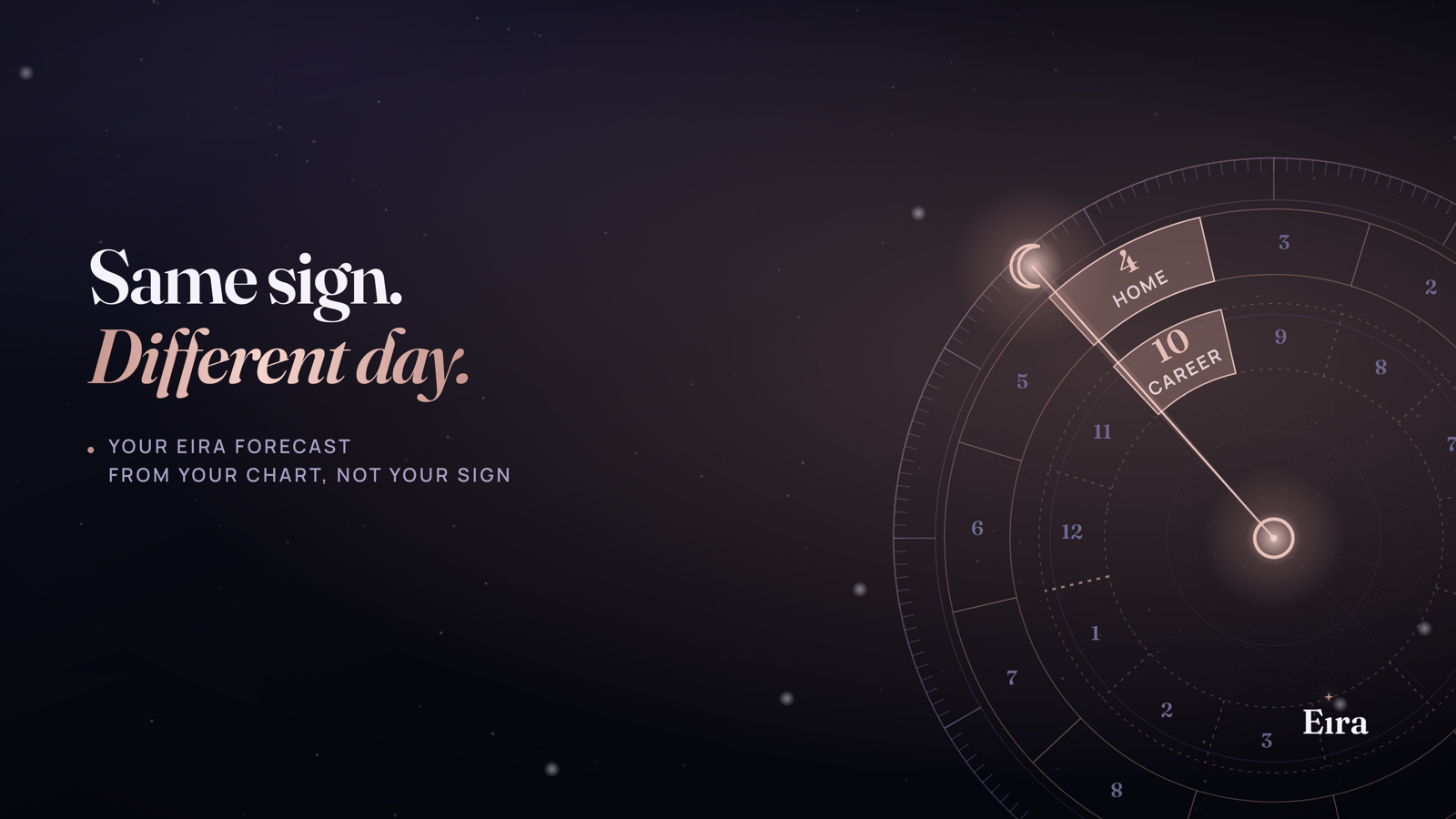
Two friends, both Scorpios, compare their Eira forecasts over breakfast. One reads: "a day for getting things done and talking about work; people are ready to listen." The other: "you'll want to stay home with your people; big decisions can wait until tomorrow." The first thought is that the app got something mixed up. Same sign, after all.
Nothing got mixed up. That's exactly how it's supposed to work: an Eira forecast is written for one person, from their own birth chart, not for a sign. Here is how it differs from a sun-sign horoscope, why two Scorpios get two different days, where the forecast lives in the app, and how to read it so it actually helps.
Sun-sign horoscope vs. a forecast from your birth chart
A sun-sign horoscope knows one thing about you: which sign the Sun was in on the day you were born. The same text is read the same morning by one in every twelve people. To spread the day across areas of life at all, a magazine horoscope takes a shortcut: it treats your Sun sign as your first house, the next sign as your second, and so on around the circle. For some people that lands close. For everyone else it misses.
An Eira forecast starts with your natal chart: your date, time and place of birth. From those it works out your Ascendant (the sign rising on the eastern horizon at the minute you were born), your twelve houses, which are the areas of your life, and where every planet sits. Then today's sky is laid over that chart: where the Moon, Sun, Mercury, Venus, Mars and the slow planets are right now, which of your houses they're moving through and which of your planets they touch.
The Sun is what you choose; the Moon is how you react. Your Sun sign describes what drives you and what you're reaching for. But a day is also made of what you react to, where things are quiet and where they're tense. You only see that in the whole chart.
Why two Scorpios get different forecasts
A different Ascendant means different houses
The Ascendant changes roughly every two hours. Two people born on the same day, twelve hours apart, share a Scorpio Sun and have completely different charts: one has Leo rising, the other Aquarius rising. So all twelve of their houses fall differently.
The same Moon moves through different houses
Say the Moon is in Taurus today. For a Scorpio with Leo rising, Taurus usually falls in the tenth house: career, and how people see you. That forecast will be about work and conversations with the people who make decisions. For a Scorpio with Aquarius rising, Taurus is the fourth house: home, family, your inner footing. That forecast will be about rest and the people closest to you. One sky, two different days: work for one Scorpio, home for the other.
Different birth planets mean different aspects
Even if the houses matched, two people have their Moon, Venus and Mars in different places. Today's Mars can form a tense aspect to one person's Moon and pass the other person's chart by entirely. In the first case the forecast will warn that tempers run short today. In the second it won't mention it at all.
How Eira builds your daily forecast
What changed since yesterday comes first. The daily forecast is built on the fast-moving planets: above all the Moon (which sign it's in, which of your houses it's crossing, which of your planets it touches), plus the Sun, Mercury, Venus and Mars. The Moon moves through a sign in about two and a half days, which is why your daily forecast is new every day.
The slow planets are the backdrop. Saturn, Uranus, Neptune and Pluto hold their aspects for weeks or months. They show up in the forecast as a short background note, never as the headline. Otherwise you'd be reading the same thing all month.
Your birth chart isn't news on its own. A natal planet makes it into the forecast only when a transit (a planet's current movement measured against your chart) touches it today. Not "you have Venus in the eighth house", but "today's Moon touches your Venus".
Nothing is made up. Every planet, sign and house in the text comes from your chart. You can check it: open your chart and find what the forecast names.
Where to find your forecast and what's in it
On the home screen, the first card is today, with a short line from your forecast. Tap "Read your day" to open "Your personal forecasts". At the top there are three tabs: Day, Week and Month.
The daily forecast: general and by topic
On the Day tab, a row of topics sits just below: General, Love, Career, Finances, Health and Mood. Each topic looks at its own part of the chart:
- Love: the seventh house (partnership), the fifth (romance), the eighth (intimacy), plus Venus, Mars and the Moon;
- Career: the tenth house and the Midheaven, the Sun, Saturn and Jupiter;
- Finances: the second house (your own money), the eighth (shared money and debt), Jupiter and Venus;
- Health: the sixth house, the Ascendant, Saturn and the Moon;
- Mood: the Moon and the fourth house.
That's why your Love and Career forecasts on the same day can sound nothing alike. They read different parts of the same chart.
The weekly forecast
The whole week: its gist in two sentences, the one or two days that matter most and why, where things flow easily, where to slow down, and a closing note.
The monthly forecast
The atmosphere of the month, its key dates, three themes for the month that are specific to you, and a tip for the month. The themes aren't "work" and "love". They come from how the month's transits meet your chart.
What's open for free
For the first seven days, during your free trial, the daily forecasts (general and every topic) and the weekly forecast are open. The monthly forecast comes with a subscription. After the trial ends, the general daily forecast stays open for one more week.
How to read your forecast
The first line is the theme of the day
Your forecast opens with a sentence or two in plain language, no astrology words: what kind of day is ahead. If you're short on time, read at least that.
Find your house
In the general forecast, the "Energy of the day" section says which of your houses the Moon is crossing today; in the topic forecasts you'll find the same in "Activated chart zones". That's the part of life where you'll react most today: home, work, money or relationships. If you want to know why, open the My chart tab and find that house. If houses and signs are still a blur, start with the beginner's guide to reading your natal chart.
Separate today from the background
Anything tied to the Moon and the fast planets is about today. A line about Saturn or Pluto describes a long stretch and doesn't ask you to decide anything today. To work out which of the long transits matters most for you, see Which Transit Matters Most for You Right Now.
Pick one action
The general forecast has a "Best actions and what to avoid" section; the topic forecasts have "Recommendations". And every daily forecast ends with a "Tip for today" line: one concrete action. Pick one thing and do it. A forecast is useful when it changes something about your day, not when you've simply read it.
Check in at night
In the evening, go back to the forecast for a minute: what matched, what didn't. After a couple of weeks you'll see which parts of your chart respond the most.
What to do and what to avoid
Do:
- check that your date, time and place of birth are exact in your profile. Your Ascendant and every house depend on the time. Why the hour matters so much is explained in Why your natal chart needs your birth time;
- read the topic that matches today's question rather than all six in a row;
- turn on forecast messages: at the bottom of the forecasts screen, tap "Manage notifications". There you'll find the "Receive daily forecast" switch and the choice of topics. The messages arrive in Eira's Telegram bot.
Avoid:
- expecting the forecast to name a specific event. Astrology describes the backdrop and your tendencies, not a script. Your forecast can tell you the day suits a conversation; it can't tell you whether they'll call;
- treating your forecast and a same-sign friend's as the "right" one and the "wrong" one. They aren't supposed to match;
- making health, money or legal decisions on the strength of a forecast. That's what doctors, financial advisers and lawyers are for.
If the forecast leaves you with a question about a specific situation, you can ask it in the chat. How to phrase it so the answer is about you is covered in How to Ask Eira So the Answer Is About You. And how the forecast differs from the short daily tip is explained in Eira's Tip of the Day.
Frequently asked questions
Why doesn't my forecast match my sign's horoscope?
A sun-sign horoscope only uses the Sun, and it's the same for one in every twelve people. An Eira forecast is calculated from your whole chart: your Ascendant, your houses and all your planets. So the themes of the day often won't line up.
My friend and I share a sign but get different forecasts. Is that a mistake?
No. You were born at different times and in different places, so your Ascendants and houses differ. Today's Moon may be crossing one person's career house and the other's house of home and family.
How often does the daily forecast change?
Every day. It's built mainly on the Moon and the fast planets, and they move noticeably in 24 hours.
What if I don't know my exact birth time?
You'll still get a forecast based on where the planets are. Without an exact time, though, the houses can shift, so take anything said about a specific house with a grain of salt. If you can find the time on a document or from family, update it in your profile.
Which forecasts are free?
For the first seven days, the daily forecasts, general and every topic, and the weekly forecast are open. The monthly forecast comes with a subscription. After the trial, the general daily forecast stays open for one more week.
Where is the forecast in the app?
On the home screen: the first card shows today and a "Read your day" button. It opens "Your personal forecasts", with Day, Week and Month tabs.
Eira builds your forecast from your natal chart, not your sign. Open your day in the app and compare it with a friend who shares your sign.