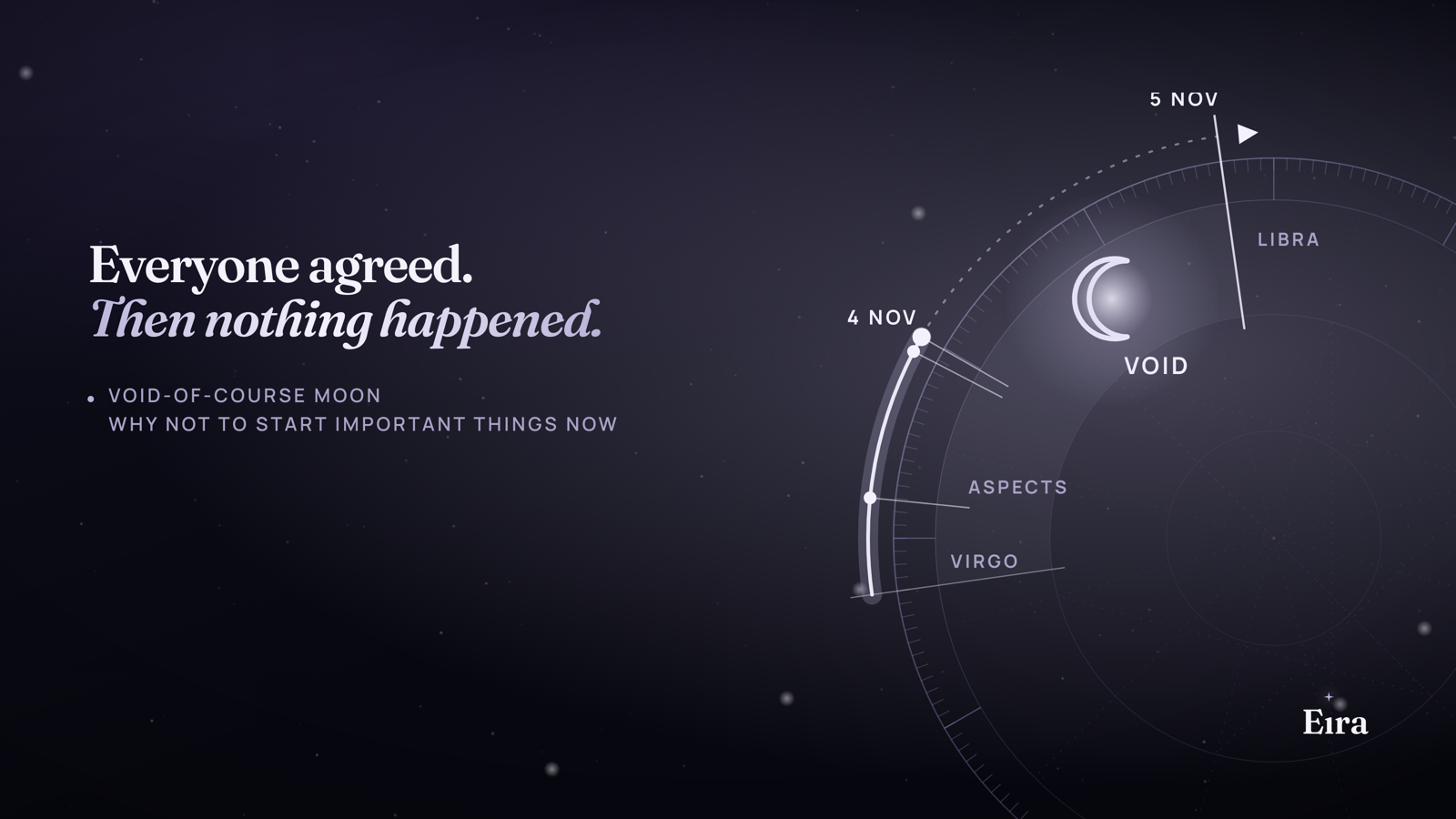
You sent the application and heard nothing back — not a yes, not a no. The call went well, everyone nodded, you agreed to "circle back next week," and nobody ever did. You bought a jacket that looked perfect in the shop, and it is still hanging in your wardrobe with the tag on. Nothing went wrong. Nothing happened at all.
This happens to everyone, and usually the reason is ordinary: people are busy, they forget, the timing was off. But astrologers have long noticed a pattern behind these stalled beginnings. Look at when the thing was started, and quite often the Moon was void of course at the time.
The short version. A void-of-course Moon is the stretch of time after the Moon has finished all its meetings with the planets in one sign but before it moves into the next. Things started in those hours tend to go nowhere. Not badly — just nowhere. So if something matters, start it before or after.
What a void-of-course Moon is
The Moon is the fastest-moving body in a chart: it crosses a zodiac sign in about two and a half days. Along the way it forms aspects with the planets one after another — it lines up with them at meaningful angles: 0°, 60°, 90°, 120° and 180°. In astrology each aspect is an event: the Moon "meets" the Sun, Venus or Saturn, and the day picks up a theme.
At some point the meetings in that sign run out. The last aspect is done, but the Moon still has some way to go before the border of the next sign. That final stretch is what astrologers call the void-of-course Moon (often shortened to "VOC Moon"). It can last anywhere from a few minutes to a day or more, and it comes round every two to three days. So it is not a rare event — it is a normal part of the lunar rhythm, like the pause between two sentences.
As soon as the Moon enters the new sign, the pause is over: there are aspects ahead again, and the day has a direction again.
Why you shouldn't start important things during a void Moon
In astrology the Moon governs the flow of everyday affairs — how things develop from the first step to the outcome. While it still has aspects ahead, whatever you begin has somewhere to go. Once there are none left, what you begin has nothing to attach to. Hence the old rule: what is started under a void-of-course Moon comes to nothing.
In real life that looks less like failure and more like a blank:
- the email goes out, no reply comes, and a week later nobody remembers it;
- the meeting covered everything, but nobody wrote down who is doing what;
- the purchase turns out to be unnecessary, the wrong size, or something you end up returning;
- the project launches with energy and quietly stalls at step two;
- a decision feels obvious, and a few days later you wonder why you made it.
In seventeenth-century horary astrology (William Lilly) this was one of the core rules: with the Moon void of course, things move slowly and rarely come to much. Lilly made an exception for the Moon in Taurus, Cancer, Sagittarius and Pisces, where in his experience the pause was gentler.
It is worth being clear about what the rule does not say. A void Moon does not bring trouble and does not "ruin" the day. It describes the background, not the script: if you spend those hours on something that does not need an outcome, you are fine. The trouble only starts with things you expect to go somewhere.
What to do while the Moon is void
These hours are good for anything that does not need a future result:
- finish what you have already started: wrap up the report, close tasks, answer old emails;
- clear out your inbox, your wardrobe, your desk, your downloads folder;
- repeat what you already know how to do: your usual workout, your usual route, routine;
- think things through and draft ideas without sending anything;
- rest, walk, sleep — a pause in the sky lines up with a pause in you;
- spend time with people you love with no agenda and no big conversations.
What to avoid
- Signing contracts or agreeing to new terms.
- Sending job applications, proposals and pitches.
- Launching a project, a website, an ad campaign or a sale.
- Making big purchases — electronics, furniture, non-refundable tickets.
- Setting up a first date or a first conversation about something important.
- Making decisions that will be hard to undo.
If something important already falls in a void Moon
Sometimes you can't move it: the interview is booked, the flight is fixed, the deadline is today. Don't put your life on hold for a calendar. The rule is about beginnings, so a few simple things help:
- Start earlier. Send the email before the pause begins, so the meeting only continues something already in motion.
- Pin down the next step. If a conversation happened under a void Moon, write down straight away who does what and by when. Things fall through exactly where an agreement is left hanging in the air.
- Double-check the details. Size, amount, date, address. "It came to nothing" usually starts with a small thing nobody checked.
- Come back to it once the Moon has changed signs — even with a short "just confirming what we agreed."
Void-of-course Moon, 5–11 November 2026
Times are for Kyiv (UTC+2). London is 2 hours earlier, Berlin 1 hour earlier, New York 7 hours earlier.
- From Wednesday 4 November, 08:57 to Thursday 5 November, 16:38. A long one, almost 32 hours: the Moon in Virgo, after meeting Mercury, moves on into Libra.
- Saturday 7 November, 15:19 — Sunday 8 November, 00:39. The Moon in Libra after meeting Jupiter, then into Scorpio.
- Tuesday 10 November, 01:25 — 10:35. The Moon in Scorpio after meeting Jupiter, then into Sagittarius.
- The next one is Thursday 12 November, 13:28 — 22:27, with the Moon in Sagittarius.
This week the pauses overlap with Mercury retrograde (until 13 November) and Venus retrograde (until 14 November). Contracts and big purchases are better moved to the second half of November anyway, and the void-Moon hours are one more reason not to rush. More on the week in the weekly horoscope for 2–8 November, and on what came into focus on 4 November in Sun conjunct Mercury.
Why calendars disagree by minutes or hours
Open two lunar calendars and the times may not match. There are three reasons. Some astrologers count only the planets visible to the naked eye (Sun through Saturn); others add Uranus, Neptune and Pluto. Some include minor angles as well. And each calendar gives times for its own time zone. The times above include every planet from the Sun to Pluto and only the five major angles. This week both approaches give the same times, because each time the Moon's last meeting is with Mercury or Jupiter.
How to check the void Moon against your own chart
The pause itself happens at the same moment for everyone — only the local clock time changes. Where it shows up in your life depends on your chart.
Step 1. Find the void hours
Use a lunar calendar that lists void-of-course periods and convert the times to your own time zone. If you are planning something important, look a week ahead: the pause can fall in the daytime or overnight.
Step 2. Find the house that sign falls in
Look at your natal chart, find the sign the Moon is void in, and see which house it falls in. That is the area of life where the pause is most noticeable: in the 2nd house, money and purchases; in the 7th, agreements with other people; in the 10th, work and reputation. If houses are new to you, start with the guide on how to read your natal chart.
Step 3. Check your own Moon
See where the Moon sits in your birth chart. If the pause runs through the sign of your natal Moon, you will probably feel it more: less energy, more of a pull to finish things than to start them. That is not a glitch — it is a cue about rhythm. For what the Moon says about you in general, see the Moon in your natal chart.
There is also a special case: people born under a void-of-course Moon. Astrologers note that they often reach their goals by their own route, and the result tends to arrive in a different way from the one they planned. You can check this with a calendar for your date and time of birth.
Void-of-course Moon in each sign
The pause is the same everywhere, but the sign colours what tends to stall and what is worth doing instead.
Void Moon in Aries
The impulse is there, the follow-through isn't: something started with a rush gets dropped an hour later. Put the energy into a workout rather than a new project.
Void Moon in Taurus
By tradition, one of the gentlest pauses. Good for food, sleep, comfort and taking care of yourself. Still, hold off on big purchases.
Void Moon in Gemini
Lots of messages, little to show for it. Threads sprawl and agreements get lost in group chats. Clear your inbox, but don't make new promises.
Void Moon in Cancer
Another gentle pause by tradition. Time for home, family, cooking and heart-to-hearts. Avoid making decisions on behalf of the people close to you.
Void Moon in Leo
You want to be seen, and the response is muted. A post, a pitch or a talk lands more quietly than you hoped. Prepare now, present later.
Void Moon in Virgo
You feel the urge to fix everything, and each fix creates another one. Good for tidying, sorting and routine. Bring in the new system later.
Void Moon in Libra
Hard to choose: every option looks the same. Don't say yes just to be polite. Time for beauty, low-key get-togethers and rest.
Void Moon in Scorpio
Suspicions and conclusions that won't hold up later. Don't have the big confrontation, and don't bet everything on a gut feeling. Better to sort through old things — papers, debts, thoughts.
Void Moon in Sagittarius
By tradition the pause is softer here. Good for reading, study and long walks. Save big plans and promises about the future until the Moon enters Capricorn.
Void Moon in Capricorn
Work happens, but nothing moves: meetings without decisions, reports without consequences. Close out old tasks and don't take on new commitments.
Void Moon in Aquarius
Ideas arrive but don't stick. Write them down so you can come back to them. Poor hours for group decisions or team launches.
Void Moon in Pisces
A gentle pause by tradition. Good for rest, music, dreams and creative work with no goal attached. Leave contracts, money and anything that needs clarity for another time.
Frequently asked questions
What does void of course Moon mean, in simple terms?
It is the time between the Moon's last aspect in a sign and its move into the next sign. The Moon won't "meet" any planet again until it changes sign. It happens every two to three days and lasts from a few minutes to a day or more.
Why shouldn't you start things during a void-of-course Moon?
The tradition says that what you begin in those hours doesn't reach an outcome: emails go unanswered, agreements are forgotten, purchases turn out to be unnecessary. It is not dangerous, just empty — so it makes sense to start important things before or after the pause.
Can I work while the Moon is void of course?
Yes. The rule is about starting things, not about working. Finishing, checking, sorting and answering old emails are actually well suited to these hours. Just don't launch anything new or take on new commitments.
When is the Moon void of course in November 2026?
For 5–11 November, Kyiv time: until 16:38 on 5 November (it began on the morning of 4 November), from 15:19 on 7 November to 00:39 on 8 November, and from 01:25 to 10:35 on 10 November. The next pause is on 12 November from 13:28 to 22:27.
What if my interview or signing falls during a void Moon?
Don't cancel it. Send your documents ahead of time, and right after the meeting confirm the next step in writing: who does what, and by when. Re-check the details — amounts, dates, terms — once the Moon has entered the next sign.
Why do void-of-course times differ between calendars?
Calendars count differently: some use only the planets from the Sun to Saturn, some add Uranus, Neptune and Pluto, and some include minor angles. Time zones add to the difference. The gap can be anything from a few minutes to a few hours.
You can see which house of your chart the pause falls in, and where your natal Moon sits, in your natal chart in Eira. All you need is your date, time and place of birth.