Anna is running a temperature of 38.4°C. In the team chat she writes: "All fine, you'll have the report by tonight." A friend offers to drop off some medicine. "Don't worry, I've got it." Then at two in the morning she lies awake, quietly furious that nobody thought to just show up.
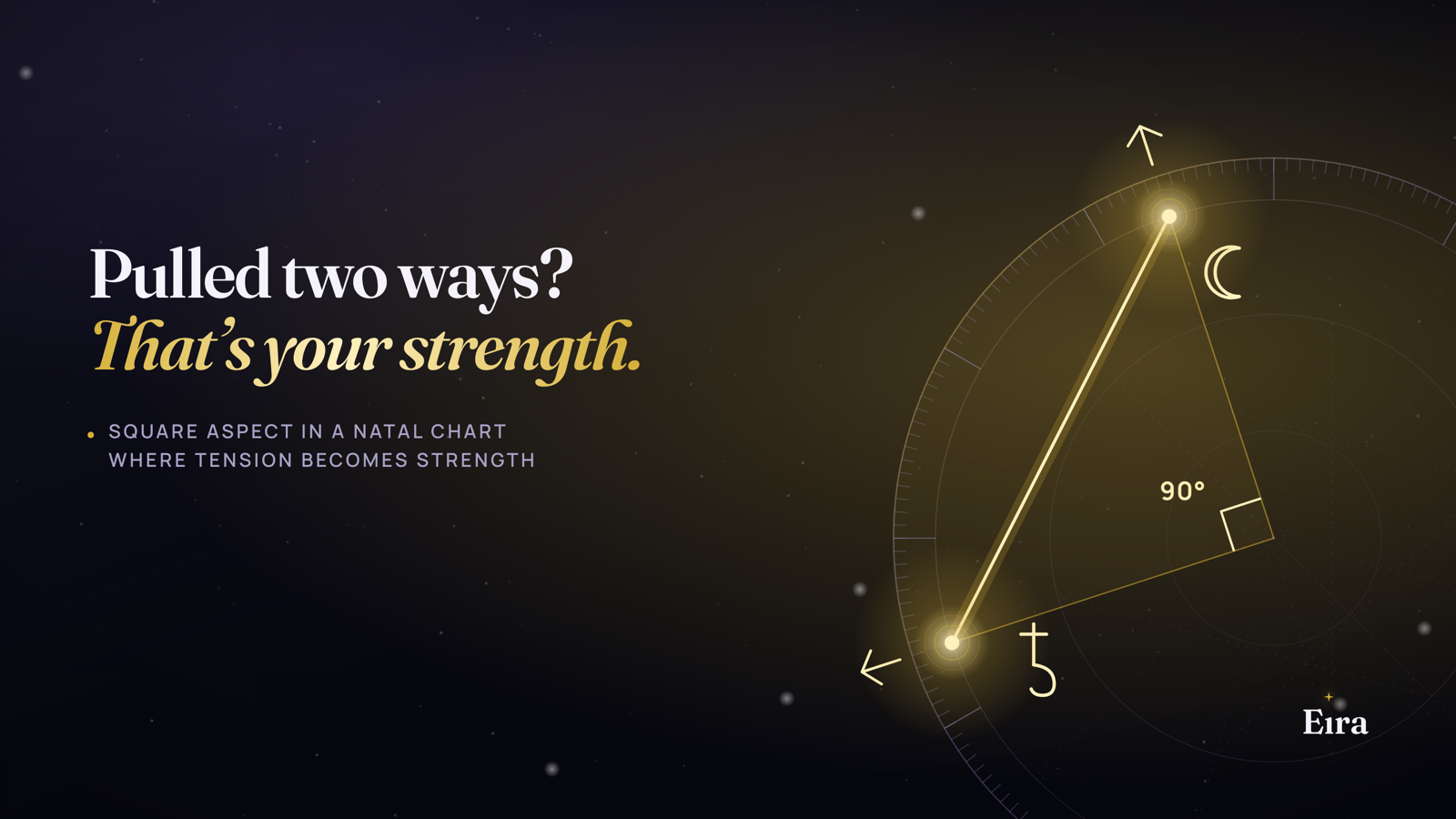
This isn't stubbornness, and it isn't pride. Two parts of Anna are arguing. One wants to be looked after. The other says, "Pull yourself together, you're an adult." Neither backs down, and each has a point. In Anna's birth chart that argument shows up as a single red line: the Moon at 14° Cancer and Saturn at 9° Aries sit roughly 90° apart. That is a square.
In one sentence: a square is two parts of your character wanting different things at the same moment, and the friction between them grows into something you eventually do better than most people.
What is a square in a natal chart?
A square is an aspect in which two planets sit 90° apart on the chart wheel, which is three signs away from each other. Aries and Cancer, Taurus and Leo, Gemini and Virgo are all "square" sign pairs. We covered aspects in general, and how to spot them, in aspects in a natal chart. This piece is only about the square, and what to do with one.
The angle doesn't have to be exact. Eira counts a square when it is within 8° of 90° if the Sun or Moon is involved, and within 7° for every other pair. The closer to exact, the louder the argument.
Squares are neither rare nor a bad grade. We ran the charts of everyone born between 1950 and 2010: 94% have at least one square, and the average is three. A chart with no squares at all is less common than a chart with five.
Why a square feels like tension
Signs that square each other belong to different elements but share the same mode of acting. Aries and Cancer both start things: Aries charges ahead, Cancer protects its people. Taurus and Leo both hold on: Taurus to what it has built, Leo to what it is proud of. Gemini and Virgo both adapt: one to whatever is new, the other to whatever is correct.
So the two planets want to act at the same time and in the same way, just in different directions. Picture two hands on one steering wheel. Neither can simply wait for the other to finish.
What sets a square apart from an opposition is where the argument happens. An opposition is a seesaw: people often hand one side of it to someone else and meet it in a partner, a boss or a child. A square stays inside. There is no one to pass it to, so for years it can feel like a personal defect: "something is wrong with me."
Nothing is wrong with you. A square is the place where your character works with effort, and effort repeated for years turns into skill.
Case study: how Anna lives with a Moon–Saturn square
In a chart, the Moon is "I react": what you need in order to feel safe. In Cancer it needs warmth, its own people, being cared for. Saturn is "I'm responsible": rules, duty, boundaries. In Aries it demands that you cope on your own, and right now.
Here is how that plays out in Anna's life:
- She doesn't ask. Asking would mean admitting she couldn't cope. Saturn won't allow it, and the Moon pays the price.
- She takes charge first. In a crisis, everyone looks to Anna. She doesn't panic, she hands out tasks. She never lets herself be weak, so there's no time to panic anyway.
- Care makes her uneasy. Accepting help feels awkward, and she rushes to "pay it back."
So where is the strength? Anna is the person you can lean on when everything falls apart. She knows how to care for people in ways others never think of: carefully planned, with something to spare, without a fuss. The square starts working for her when Saturn serves the Moon instead of bossing it around. For instance, when Anna puts rest in her calendar as a non-negotiable meeting, and actually keeps it.
Squares by planet pair: the most common and the most important
Read a square as a clash between two wants. Below are the pairs that produce the most recognisable scenes. Each planet has its own deep dive too, for example Mars in your natal chart and the Moon in your natal chart.
One note first: you will never find the Sun square Mercury or the Sun square Venus in a chart. Mercury never gets more than 28° from the Sun, and Venus never more than 47°. Mercury and Venus never square each other either.
Sun square Moon
What you choose and what you need don't line up. You decide one thing and feel another. About one person in eleven has this square. The strength: seeing a situation from both sides, and understanding people who are torn the same way.
Sun square Mars
Plenty of energy and a constant sense that something is in your way. Anger arrives before you have decided whether you need it. The strength: stamina, and the nerve to start what others won't.
Sun square Saturn
A strict inner examiner: "not good enough yet, don't celebrate." Recognition comes late and through hard work. The strength is mastery: by 40, people with this square often know their field better than anyone around them.
Moon square Mars
A feeling turns into an action instantly: hurt, then a reply, then the thinking. The strength: honest reactions and the ability to defend your people on the spot.
Moon square Saturn
Anna's argument exactly: "I need care" versus "deal with it yourself." The strength: the kind of steadiness other people lean on, and the ability to care for others without drama.
Moon square Venus
What you like and what calms you are two different things. You're drawn to people and things that leave you uneasy afterwards. The strength: a fine eye and a gift for making a place feel like home.
Mercury square Mars
The argument starts before the other person has finished speaking. Words come out sharper than intended. The strength: a fast mind and a firm position. Good negotiators and good editors often have this one.
Mercury square Saturn
Doubt in every sentence: "what if it sounds stupid," "better check it again." Speaking up is hard, writing is easier. The strength is precision: if this person says something, it has been checked.
Venus square Mars
Desire and tenderness pull in different directions. Relationships have a spark, and some friction with it. The strength: passion, and never getting bored in a long relationship. More on Venus in Venus in your natal chart.
Venus square Saturn
Love feels like something you have to earn. Fear of not being needed, caution with feelings. The strength: loyalty, and relationships that only get stronger with time.
Mars square Saturn
Accelerator and brake pressed at the same time. Anger stays inside or comes out late. The strength: patience, and finishing what others would abandon halfway.
Squares to Jupiter
Jupiter enlarges whatever it touches. In a square it does that through "too much": too many promises, too much spending, too many plans. The strength: generosity, and a belief that things will work out, which is often proved right.
Squares to Uranus, Neptune and Pluto
These planets move slowly, so their squares to one another are shared by whole generations and say very little about you personally. What matters are their squares to the Sun, Moon, Mercury, Venus and Mars. Uranus brings sudden breaks and a low tolerance for control, Neptune brings blur and self-doubt, Pluto brings "all or nothing." More on the last one in Pluto in your natal chart.
Squares by sign: who your sign argues with
If your Sun is in a given sign, planets in the two signs three places away can square it. Check whether you have planets there, and if you do, compare the degrees: it only counts as a square if the numbers are close.
Aries: square Cancer and Capricorn
"I want it now" against "what about the people I love" and "what about the rules." Waiting and getting sign-off is hard for Aries, yet that is exactly what makes its wins last.
Taurus: square Leo and Aquarius
Comfort against the urge to shine and the urge to change everything. Taurus feels pushed out of its routine. The strength shows when it changes on its own terms.
Gemini: square Virgo and Pisces
Lightness against precision and against feeling. "Say it fast" versus "say it right" and "say it gently." The strength: words that are both accurate and alive.
Cancer: square Aries and Libra
Care against your own drive and against the wish to keep everyone happy. A straight "no" is hard for Cancer. The strength: protecting your people without losing yourself.
Leo: square Taurus and Scorpio
Leo wants to shine; life asks for patience and honesty with yourself. The strength: pride that rests on real work.
Virgo: square Gemini and Sagittarius
Order against scattered attention and against big ambitions. Virgo wants to check everything while the world wants to move on. The strength: doing big things, and doing them properly.
Libra: square Cancer and Capricorn
Harmony against feelings and against duty. Libra wants everyone to be fine and keeps being forced to choose. The strength: fair decisions that aren't afraid of upsetting someone.
Scorpio: square Leo and Aquarius
Depth against the wish to be seen and against cool independence. Opening up is hard for Scorpio. The strength: closeness that has both trust and room to breathe.
Sagittarius: square Virgo and Pisces
Freedom against details and against compassion. Sagittarius wants to race ahead and keeps being pulled back to small print and other people's feelings. The strength: a belief that survives contact with the facts.
Capricorn: square Aries and Libra
The plan against impulse and against relationships. Capricorn finds it hard to allow itself haste or weakness. The strength: a goal you don't have to reach alone.
Aquarius: square Taurus and Scorpio
Freedom against attachment and against deep emotion. Aquarius finds it easier to think about humanity than about the person in the next room. The strength: changes that hold for years.
Pisces: square Gemini and Sagittarius
Intuition against logic and against bluntness. Pisces feels things but struggles to explain them. The strength shows when a feeling gets words and a direction.
The T-square and the grand cross
A T-square is two planets facing each other (an opposition) with a third square to both, forming the letter T. The third planet, the apex, carries the whole argument: the tension comes out through it. T-squares are common. In our count, roughly one person in three has one. Look at the house the apex falls in: that is where the person's main field of action, and main work, lies.
A grand cross is four planets, each square to two neighbours and opposite the fourth. About one person in sixty has one. It feels like being pulled from every side at once. The upside: people with a grand cross rarely break, because holding their shape under pressure is normal for them.
How a square changes with age
A square in your birth chart never goes away. What changes is how you handle it. When you're young, one side usually wins, then the other: at twenty, Anna would vanish into work for weeks, then crash and ignore every message for a week. After thirty, many people learn to give each side its own time.
There are also years when squares get louder, because slow planets in the sky form squares to their own positions in your chart:
- around ages 7, 22, 36–37 and 51: Saturn squares its birth position. Questions of duty, work and being a grown-up;
- around 20–21: Uranus does the same, with an urge to break free and do it your way;
- around 40–41: Neptune, when old goals suddenly feel like someone else's;
- Pluto, at an age that depends on your birth year: roughly 36–39 for people born between 1960 and 1980, about 43 for those born in 1990, about 50 for those born in 2000.
If an old inner argument flares up at one of these ages, you are not going backwards. You are on the next lap of the same task. Anna is going through her Saturn return right now: at 29, Saturn has come back to where it stood when she was born, and the old question "am I allowed to ask?" has come back with it.
Reading your own chart in three steps
Step 1. Find your squares
In Eira, open your natal chart and go to the "Aspects" tab: squares sit in the "Where the tension is" group, tightest first. On the wheel, a square is a red line. Without the app, look for planets in signs three apart and compare degrees: within 7–8° is a square. For the whole chart, start with how to read your natal chart.
Step 2. Name the argument in one sentence
Take your tightest square and fill in the blanks: "Inside me, ___ argues with ___." The Sun is what I choose, the Moon is what I need, Mercury is how I think and talk, Venus is what I love, Mars is how I act, Saturn is what I owe. Once the argument has a name, it stops being "something is wrong with me" and becomes a task.
Step 3. Find where the argument has already become strength
Look at the houses both planets sit in: those are the areas of life where the argument surfaces. Then ask yourself what you do better than others in those areas, and what you learned through difficulty. The answer almost always sits right where the square is.
A square in the sky next week
Squares also form between planets in the sky. On 18 November the Sun in Scorpio makes an exact square to Jupiter in Leo, and on 19 November to Mars, also in Leo (Mars stays there until 26 November). If your chart has planets in the last third of Taurus, Leo, Scorpio or Aquarius (20° to the end of the sign), these days will show your own "hold on" versus "show it" argument especially clearly.
What to do with a square
- Don't pick a winner. Both sides of a square are needed. The job is not to silence one, but to give each its place and its time.
- Turn the argument into action. A square generates energy, and energy needs a job: sport, a hard project, a craft where you have to push through.
- Notice the repeat. If the same fight keeps happening in different relationships, it is most likely your square, not the people around you.
What to avoid
- Treating a square as a verdict: "I have a bad chart." Almost everyone has hard aspects.
- Waiting for it to pass. It won't, but it will become manageable.
- Blaming everything on the square. It describes a task; it doesn't excuse behaviour.
Frequently asked questions
Is a square in a natal chart bad?
No. A square is a hard aspect: it makes life more effortful, and that is exactly what builds character and strength. 94% of people have at least one. It only turns into a problem when the argument goes unnoticed and gets settled the same way for years.
What is the difference between a square and an opposition?
An opposition (180°) is a seesaw between two sides, and people often see one of them in someone else. A square (90°) is an argument inside: two parts of your character want to act at the same time, in different directions.
What orb does a square have?
Eira counts a square within 8° of exact if the Sun or Moon is involved, and within 7° for other planets. A square that is 1–2° from exact feels far stronger than one at 6–7°.
What is a T-square in a natal chart?
A pattern of three planets: two in opposition and a third square to both. The third planet is the apex, the point through which the tension turns into action. Roughly one person in three has a T-square.
Can you work through a square?
You can't remove it; it stays in your chart for life. You can learn to live with it, though: name the argument, give both sides time and channel the tension into something useful. Most people get better at this with age, especially after 30.
What does it mean if my chart has no squares?
That happens to about 5–6% of people. Life with such a chart isn't necessarily easier: tension can arrive through oppositions or through other people. And squares from planets in the sky, known as transits, happen to everyone.
Eira builds your natal chart from your date, time and place of birth. The "Aspects" tab shows which squares you have and how exact they are, and in the chat you can ask what your main square means for you specifically.