A month ago life was ticking along. Now you have woken up three mornings in a row thinking it is time to quit your job. Or the opposite: the email you meant to send back in September is still sitting in drafts, and every day there is a new reason not to touch it. A friend says everyone feels like this in autumn. You are not so sure it is the autumn.
"Why has everything suddenly started moving — or ground to a halt?" Eira has a section for exactly that question. It is called "Your period", and it is free. Here is what it shows, how it picks the event, how long a period lasts and why the section is open to everyone.
What "Your period" in Eira is
"Your period" is the one thing happening in the sky right now that touches your birth chart. Not the whole sky at once — just the event that matters more for you than anything else.
Every day the planets form angles to the points of your natal chart and move from one of its houses to the next. Astrologers call these contacts transits. There are dozens of them in a month, and you will not notice most. The section goes through everything coming up and keeps one: the transit you are most likely to feel in your actual life. That is what you see, with its dates and a reading.
This is not a sun-sign horoscope. Two people born on the same day, but in different cities or at different times, can get different periods, because their houses and Ascendant fall differently.
What you will see in the section
The event, in plain words
The headline says what is going on without the jargon: "Venus enters your house of relationships", "Saturn is meeting your Moon", "Jupiter is in harmony with your Sun". Houses in the app are named by what they are about — not "the 7th house" but "the house of relationships", not "the 2nd" but "the house of money and ground".
A timeline: start, now, end
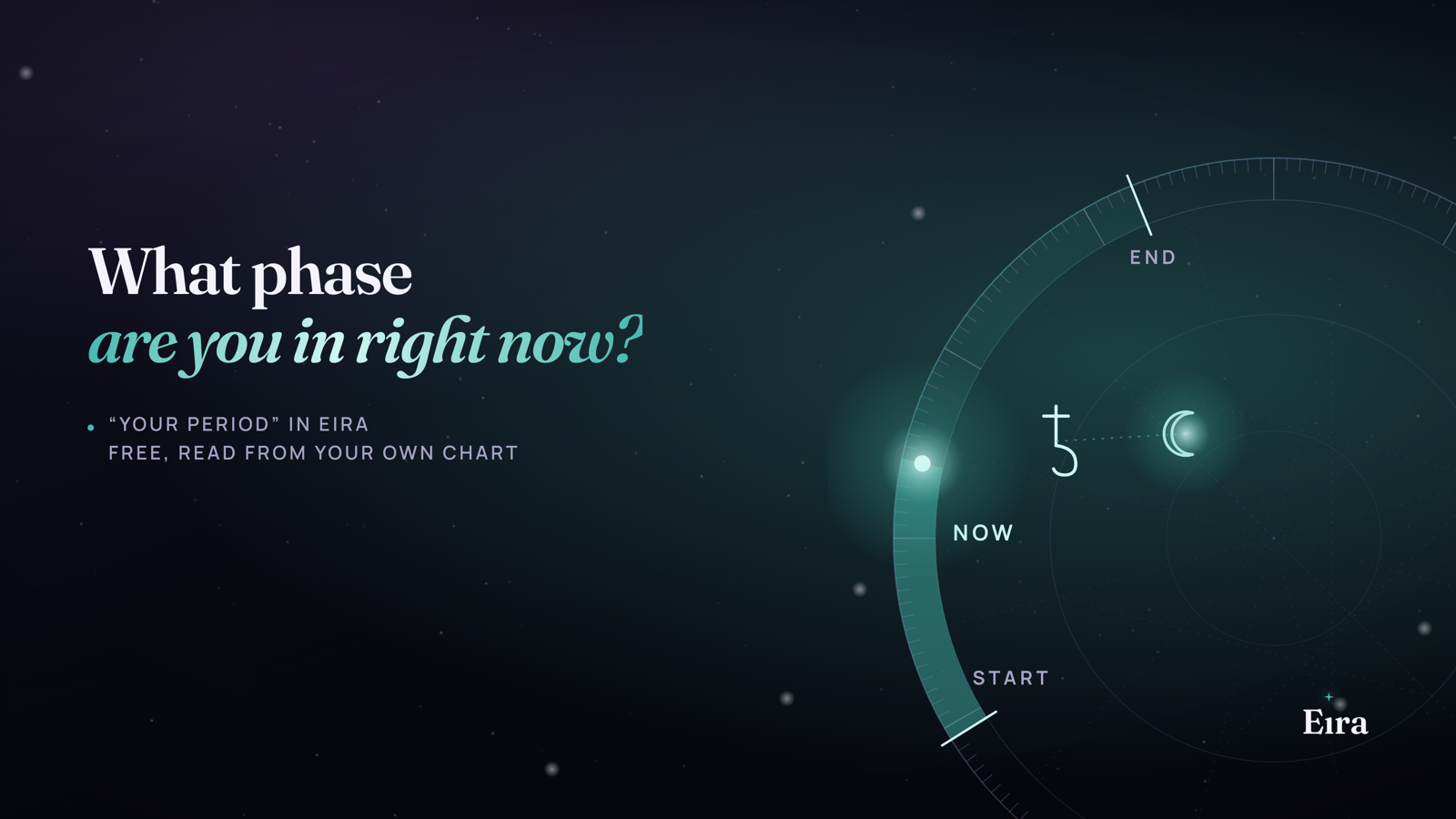
Under the headline you get the dates of the window and where it stands: "starting soon", "under way" or "winding down". Below that is a timeline with a dot marking where you are inside the period, and a countdown such as "5 days left". If the planet is moving backwards at the time (retrograde), a note appears under the timeline: "coming back to this". The theme is not new — it is returning.
A reading based on your chart
The text opens with a line or two about what you may already be noticing. After that there are usually three parts. "What is happening" names the planet and where it has landed in your chart. "What it means for you" leans on your own natal placements and on the area of life the event touches. "What to watch for" gives you two or three things to check over the next few days. The dates are not repeated in the text — they are already printed above it.
"What's next"
At the bottom you will find up to three events that come after the current period ends. Only things that are both notable and personal make the list: slow planets contacting your chart, and Mars or Venus entering one of your houses. Events everyone shares, like "the Sun enters Sagittarius", are left out — they are about the calendar, not about you. If the coming months hold nothing of the kind, the block simply does not appear.
"Discuss with Eira"
Below the reading there is a button that opens the chat and hands it the text of this reading. Eira then answers about your period, not about transits in general: you can ask what a particular sentence means, or describe what is actually going on in your life. For tips on wording a question so the answer is sharper, see "How to ask Eira".
How Eira picks one event out of many
First, whatever you would call "me"
Transits to the Sun, the Moon and the Ascendant carry the most weight: these are the three points people recognise as "that's me". Next come the Midheaven, Mercury, Venus and Mars. A planet entering your 1st, 4th, 7th or 10th house counts for more than the others, because those are the four areas people notice straight away — how you come across, home and family, your partner, your work. For more on why some transits land harder than others, read "Which transit matters most for you right now".
Slow planets count for more
Pluto, Uranus, Neptune and Saturn reshape a life more deeply than the fast planets, so they get extra weight. Pluto is the heaviest: its transits run for years and feel like a rebuild. Jupiter gets no extra weight: its transits are milder and pass sooner.
Several contacts by one planet make one period
Sometimes a single planet touches two points of your chart within a couple of days — say, your Sun and your Mars. For you that is one period, not two. The section shows the stronger contact and folds the other into the reading as reinforcement.
The section is never empty
If nothing big is due in the next ten days, Eira looks a month ahead and shows what is about to begin. If there is nothing there either, it shows which of your houses the Moon is crossing today. The Moon moves through all twelve houses in about 28 days, so there is always an answer. In that case the reading is written to scale: the mood of a day or two, not a turning point in your life.
Why your period changes, and how long it lasts
Every event has a window. While it is open, the section keeps the same event and the same reading: the text is written once and saved for the whole window, so the section does not jump to a new theme every morning. When the window closes, the next event takes its place.
Jupiter, Saturn, Uranus, Neptune, Pluto: about six weeks
A slow planet's contact with a point in your chart runs roughly three weeks before the exact moment and three weeks after. Saturn's whole passage through a house takes years, but the section stays on the stretch you feel most — otherwise you would be reading the same text until 2029. A similar long milestone is covered in our piece on the Saturn return.
Mars and Venus: about ten days
Mars is about action and anger, Venus about relationships and what you value. Their periods are shorter but easy to recognise: suddenly you want to have it out with someone — or to forgive everything.
The Sun and Mercury: a few days
Usually four days around the exact moment. These periods show up when there is nothing bigger nearby.
The Moon: one day
The fastest option, and the smallest in scale.
Why the section is free
"Your period" is always open: during the trial days, after them and with a subscription. No locks, no limit. The detailed day, week and month forecasts, the life-area readings and the karmic reading are subscription features, and some of them are open during the trial. Besides your period, the advice of the day also stays free.
The reason is simple: everyone should have a reason to look at their own chart. Someone whose trial week has ended still opens the app and finds something new and personal, not just old texts. For subscribers the section adds to the forecast: the forecast is about the day, the period is about what lasts for weeks.
How to use it
Open it, read it, check it in the evening: did it land or not? That is how you see what is actually going on in your chart.
Do. Look at the timeline: early in a period the theme is still building, towards the end it lets go. Pick one thing from the reading that you could notice today, and check it at night. Glance at "What's next" so you know what theme is coming. If a sentence does not ring true, ask about it in the chat — it is the quickest way to see where the reading hit and where it missed.
Don't read a period as a verdict or a promise of events: astrology describes the weather, not the script. Don't put your life on hold "until the period is over" either — the window shows when a theme is loudest, not when something is allowed. And don't measure your period against a friend's just because you share a sign: your charts are different, and that is fine.
How to see your period in your natal chart
Step 1. Find the point named in the headline
If the headline says "your Moon", open "My chart", then "Planets", and find the Moon: sign, house, degree. That is the place in your chart being touched right now.
Step 2. Look at the house
If the headline is about entering a house, open the "Houses" tab in "My chart" and find that house and any planets in it. A house of relationships with your Venus in it plays out very differently from an empty one. If houses are still a mystery, start with our step-by-step guide to reading a natal chart.
Step 3. Check it against your life
Think back to what was happening in that area when the window opened. The match is often easier to see in hindsight than in the moment.
Where to find it and what you need
Home screen → the "Your period" card → "Read the reading". The card already tells you how many days are left, or when the period begins.
All you need is a natal chart: your date and city of birth, and ideally the time. Without an exact time the chart is cast for noon, the houses are approximate, and "enters your house…" events can shift. Why that matters is explained in "Why your birth time matters".
If the reading is not ready yet, you still see the event, the dates and the timeline — those are worked out instantly, and the text follows a little later.
Frequently asked questions
What is "Your period" in Eira?
A free section that shows the one event in the sky touching your natal chart right now: which planet, which of your points or houses, and from when to when. Below it you get a reading based on your chart and the events coming next.
Is it really free for good?
Yes. It is open during the trial, after it and with a subscription. The subscription covers the detailed day, week and month forecasts, the life-area readings and the karmic reading.
Why do my friend and I have different periods if we share a sign?
Your sign is only where the Sun was. A period is worked out from the whole chart — the Moon, the Ascendant, the houses, the planets. Those sit differently for people of the same sign, so their events differ too.
How often does the period change?
When the event's window closes. For the slow planets that is about six weeks, for Mars and Venus about ten days, for the Sun and Mercury a few days, for the Moon one day. While the window is open, the reading stays the same.
What does "The Moon is crossing your house…" mean?
It means nothing big is close, so the section shows the fastest thing there is: which area of your life the Moon is lighting up today. It is about the mood of a day or two, not a major shift.
Do I need my birth time?
It helps. Without it the houses are approximate, so events about planets entering houses may be off. Contacts to planets depend on the time much less. You can add or correct the time in your profile.
Build your chart in Eira and open "Your period" to see which phase you are in right now — then check it against your day tonight.